


Mizuno Wave Sky 8 and Wave Sky 9 Review: Exceptional Comfort for Serious Mileage
After using the Mizuno Wave Sky through sustained running mileage, we found a highly cushioned daily trainer that delivers exceptional comfort, dependable protection and impressive long-run value.
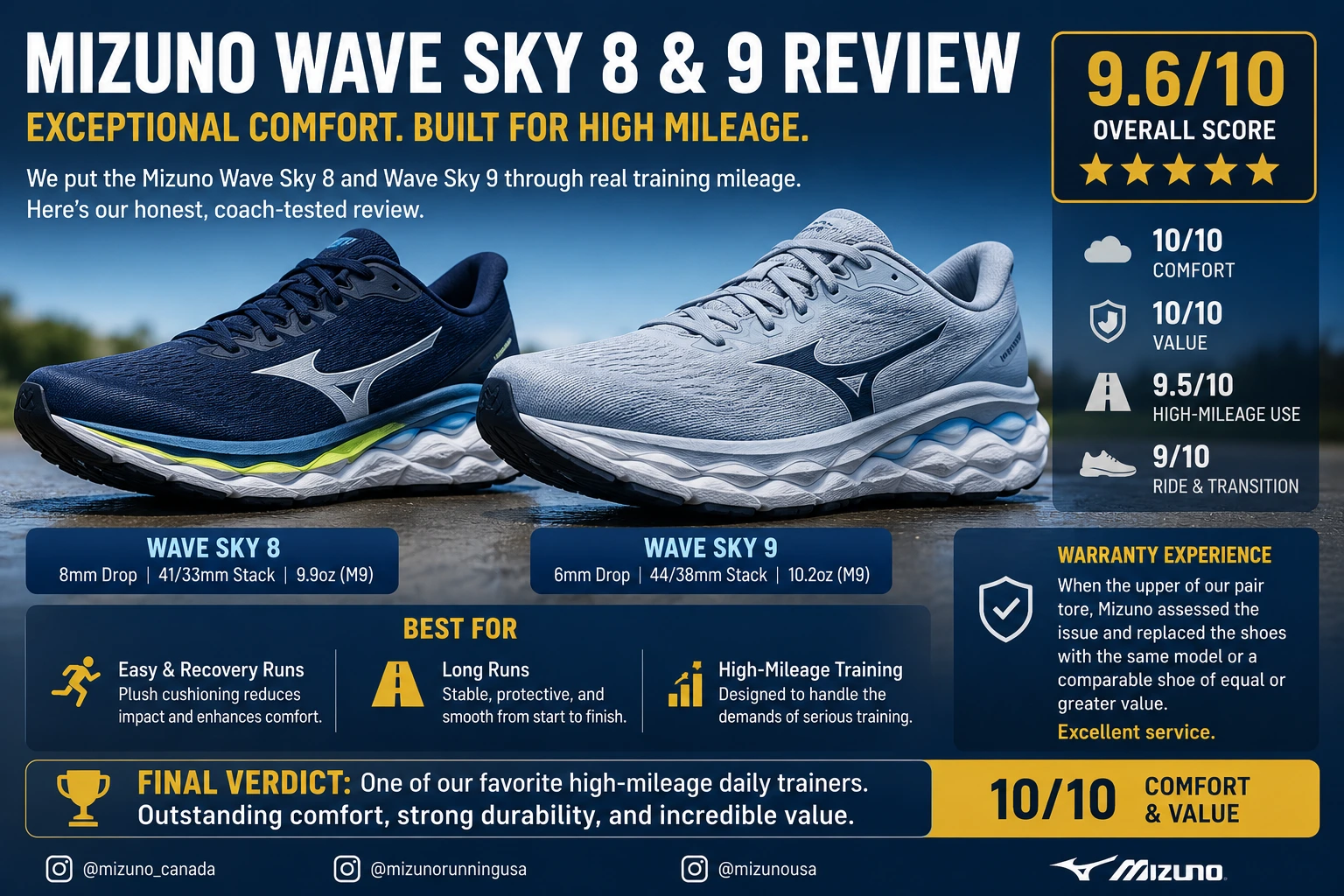
The Mizuno Wave Sky 8 is one of the most comfortable high-mileage training shoes we have used. It provides substantial cushioning without feeling unstable, handles repeated aerobic mileage well and offers a smooth heel-to-toe transition that makes long and easy running feel less punishing on the legs.
The newer Mizuno Wave Sky 9 continues the same core identity. It remains a maximum-cushion neutral trainer built primarily for comfort, protection and sustained mileage rather than aggressive racing or short, explosive speed sessions.
Neither version is intended to be the lightest or fastest shoe in a runner’s rotation. That is not its purpose. The Wave Sky is most valuable when the goal is to complete easy runs, recovery days, long aerobic sessions and large training weeks with greater comfort.
The quick verdict
For runners seeking plush cushioning, a secure platform and a dependable shoe capable of absorbing regular training mileage, the Wave Sky 8 and Wave Sky 9 are excellent choices. We give both models a 10/10 for comfort and value, with the overall score reduced slightly only because they are not designed as lightweight racing or high-speed workout shoes.
Mizuno Wave Sky 8 review: what makes it so comfortable?
Comfort is the defining strength of the Wave Sky 8. The cushioning feels substantial from the moment the foot lands, but the platform does not collapse excessively or create the uncontrolled softness sometimes found in maximum-cushion shoes.
This balance is important during high-mileage training. A shoe can feel impressively soft during a short store test but become unstable, tiring or inefficient once a runner spends an hour or more in it. In our experience, the Wave Sky 8 remained controlled and comfortable as the duration of the run increased.
The shoe’s broad platform, generous midsole and smooth transition make it particularly effective when the legs are tired from previous workouts. It is the type of shoe runners may naturally select the day after a hard track session, threshold workout or long run.
What type of running is the Wave Sky best suited for?
The generous cushioning reduces the harshness of repetitive impact and makes relaxed running more comfortable when the legs are carrying fatigue.
The protected ride and stable base make the shoe well suited to longer runs where maintaining comfort becomes more important than minimizing every gram.
Runners completing frequent weekly mileage may appreciate having a durable, cushioned trainer that can absorb a substantial share of their easier running.
Mizuno Wave Sky 8 and Wave Sky 9 specifications
The men’s Wave Sky 8 uses an 8 mm heel-to-toe drop, with a 41 mm heel and 33 mm forefoot stack. The listed weight is approximately 9.9 oz for a men’s US size 9.
The Wave Sky 9 changes the geometry to a 6 mm drop, with a 44 mm heel and 38 mm forefoot stack. It provides more cushioning under the entire foot, particularly in the forefoot.
| Specification | Wave Sky 8 | Wave Sky 9 | Practical effect |
|---|---|---|---|
| Category | Neutral / maximum cushion | Neutral / maximum cushion | Best suited to comfortable daily training, recovery and longer aerobic running. |
| Heel-to-toe drop | 8 mm | 6 mm | The Wave Sky 9 provides a slightly flatter platform, while the Wave Sky 8 offers the more traditional 8 mm geometry. |
| Heel stack | 41 mm | 44 mm | Both are highly cushioned, with the Wave Sky 9 becoming even taller under the heel. |
| Forefoot stack | 33 mm | 38 mm | The Wave Sky 9 adds a substantial amount of cushioning under the forefoot. |
| Listed men’s weight | Approximately 9.9 oz | Approximately 10.2 oz | Neither model is an ultralight trainer, but the weight supports the protective high-stack construction. |
| Primary use | Daily mileage and long runs | Daily mileage and long runs | Both shoes prioritize comfort and protection over racing speed. |
Wave Sky 8 versus Wave Sky 9: what changed?
The Wave Sky 9 is not simply the Wave Sky 8 with a new upper or colour. The geometry changes noticeably.
The Wave Sky 8 uses an 8 mm drop with a 41 mm heel and 33 mm forefoot. The Wave Sky 9 moves to a 6 mm drop with a 44 mm heel and 38 mm forefoot.
That means the Wave Sky 9 places more material under the entire foot, especially the forefoot, while reducing the difference in height between the heel and toe.
ITC performance perspective
Runners who enjoyed the more traditional 8 mm geometry of the Wave Sky 8 may prefer its familiar heel-to-toe relationship. Runners who want an even more substantial forefoot platform may prefer the Wave Sky 9.
A lower numerical drop is not automatically better or worse. The appropriate choice depends on the runner’s mechanics, training history, calf and Achilles tolerance, and preferred sensation underfoot.
Can the Mizuno Wave Sky handle high mileage?
Based on our use, this is one of the strongest reasons to consider the Wave Sky.
The shoe tolerated repeated training mileage while maintaining the comfort expected from a maximum-cushion daily trainer. It did not feel like a shoe reserved only for occasional recovery runs. It was capable of carrying a meaningful portion of the weekly training load.
Durability always depends on the runner’s body mass, gait, landing pattern, running surface, weather, shoe rotation and maintenance. No responsible review should promise a specific mileage total for every runner.
Nevertheless, the Wave Sky platform feels designed for repeated use rather than short-term novelty. For runners whose priority is comfort across many aerobic kilometres or miles, that matters more than having the lightest possible shoe.
How does the Mizuno Wave Sky feel during a long run?
The Wave Sky’s greatest advantage becomes more noticeable as a run continues. During the early kilometres, many modern trainers feel comfortable. The more meaningful question is whether that comfort remains once the legs begin to fatigue.
In the Wave Sky 8, the cushioning remained protective without creating an excessively soft or unstable sensation. The heel-to-toe transition felt natural, and the 8 mm drop worked well for steady daily mileage.
The shoe does not force the runner aggressively onto the forefoot. Instead, it provides a smooth and forgiving transition that should appeal to many heel and midfoot strikers completing controlled aerobic work.
Is the Mizuno Wave Sky suitable for speed workouts?
It can complete moderate running and controlled progression work, but it would not be our first choice for short intervals, maximal track sessions or racing.
The cushioning and protective build that make the Wave Sky excellent for daily mileage also make it heavier and less aggressive than a dedicated tempo or racing shoe.
Athletes who use a shoe rotation may pair the Wave Sky with a lighter, more responsive model for intervals, threshold workouts and competition. This allows the Wave Sky to perform the role it handles best: protecting the legs during the majority of easier training.
What we liked
- Exceptional step-in and long-run comfort
- Highly cushioned without feeling uncontrolled
- Well suited to easy, recovery and long aerobic runs
- Capable of handling sustained weekly mileage
- Smooth and comfortable heel-to-toe transition
- Strong value when purchased at a competitive price
- Positive personal experience with Mizuno customer service
- Wave Sky 9 continues the successful cushioned identity
What runners should consider
- Heavier than a dedicated tempo or racing shoe
- Not designed primarily for short, explosive intervals
- Maximum cushioning may be more shoe than some runners want
- Wave Sky 9 changes from an 8 mm to a 6 mm drop
- Fit and comfort remain individual and should be tested
Our experience with the Mizuno warranty process
During our use, the upper of one pair tore. We contacted Mizuno and submitted the issue for assessment. Mizuno handled the claim professionally and replaced the damaged shoes with the same model or a comparable shoe of equal or greater value.
That was an excellent customer-service experience and significantly increased our confidence in Mizuno as a brand.
It is important to distinguish our experience from a universal warranty promise. Warranty decisions may depend on the product, purchase date, proof of purchase, nature of the damage, normal wear, intended use and Mizuno’s assessment of whether the problem represents a covered defect.
Runners in Canada or the United States should retain their original receipt and contact the retailer or Mizuno customer support when a possible manufacturing defect arises.
Is the Mizuno Wave Sky worth the price?
In our experience, yes.
Running-shoe value should not be judged only by the lowest retail price. A less expensive shoe that becomes uncomfortable, loses its structure quickly or cannot handle the runner’s normal mileage may offer poor long-term value.
The Wave Sky earns its value through comfort, usability and the amount of training it can support. For a runner using it frequently for recovery runs, easy mileage and longer aerobic sessions, the cost can be justified by the role it performs.
We rate both the Wave Sky 8 and Wave Sky 9 10/10 for comfort and value. That rating reflects the quality of the ride, the mileage capability and our positive customer-care experience—not a claim that the shoe will be perfect for every runner.
Who should buy the Wave Sky 8 or Wave Sky 9?
Consider buying it if:
- You prioritize cushioning and comfort
- You complete frequent easy or recovery mileage
- You want a protective long-run shoe
- You prefer a neutral rather than posted stability shoe
- You value a smooth, non-aggressive transition
- You want a dependable shoe for large training weeks
Consider another model if:
- You want the lightest possible racing shoe
- Your main focus is short, fast track work
- You strongly prefer a firm and minimal ride
- You are transitioning to lower-drop shoes without preparation
- You require a medically prescribed support shoe
Wave Sky 8 or Wave Sky 9: which should you choose?
Choose the Wave Sky 8 if you already know that an 8 mm drop works well for you, prefer its slightly lighter listed weight or find it available at a strong clearance price.
Choose the Wave Sky 9 if you want the newer, taller platform, prefer more cushioning under the forefoot or are comfortable using a 6 mm drop.
The Wave Sky 8 may represent particularly strong value when discounted, while the Wave Sky 9 provides the newest version of Mizuno’s maximum-cushion daily trainer.
For runners who already own and enjoy the Wave Sky 8, moving to the Wave Sky 9 should still be treated as a shoe change because the drop and stack geometry are different. Introduce the new model progressively rather than assuming the two versions are mechanically identical.
Mizuno Canada and Mizuno USA
Canadian and American runners should confirm current colours, sizes, prices and warranty procedures through the official regional Mizuno websites. Product availability and warranty processes may differ by country and retailer.
Final verdict: one of our favourite high-mileage comfort shoes
The Mizuno Wave Sky 8 succeeded because it delivered exactly what a maximum-cushion daily trainer should provide: comfort, protection, smooth transitions and the ability to absorb repeated training mileage.
The Wave Sky 9 continues that identity while adding a taller platform and changing the drop from 8 mm to 6 mm. It remains best understood as a comfortable mileage shoe rather than a lightweight speed specialist.
Our rating is 10/10 for comfort and value and 9.6/10 overall. For recovery running, long aerobic sessions and everyday mileage, the Wave Sky line deserves serious consideration from runners in Canada, the United States and beyond.
Frequently asked questions
Is the Mizuno Wave Sky 8 good for long-distance running?
Yes. Its high level of cushioning, broad platform and smooth transition make it well suited to long aerobic runs and sustained daily mileage. Individual fit and biomechanics should still be considered.
What is the drop of the Mizuno Wave Sky 8?
The men’s Mizuno Wave Sky 8 has a heel-to-toe drop of 8 mm, with a 41 mm heel and 33 mm forefoot stack.
What is the drop of the Mizuno Wave Sky 9?
The men’s Mizuno Wave Sky 9 has a 6 mm drop, with a 44 mm heel and 38 mm forefoot stack.
Is the Wave Sky 9 the same as the Wave Sky 8?
No. Both are maximum-cushion neutral trainers, but the Wave Sky 9 uses a taller stack and a lower 6 mm drop compared with the Wave Sky 8’s 8 mm drop.
Is the Mizuno Wave Sky good for recovery runs?
Yes. Recovery running is one of its strongest uses because the shoe prioritizes cushioning, protection and comfort over minimal weight or aggressive speed.
Is the Mizuno Wave Sky a racing shoe?
It can be used in running events, but it is primarily a cushioned daily trainer. Most runners seeking maximum speed would choose a lighter and more responsive dedicated racing shoe.
Does Mizuno replace shoes with a torn upper?
Mizuno approved a replacement in our particular case after the damaged upper was assessed. Coverage is not automatic and depends on the applicable warranty, proof of purchase, nature of the damage and Mizuno’s claim decision.
Is the Mizuno Wave Sky 8 better than the Wave Sky 9?
Neither is automatically better. The Wave Sky 8 may suit runners who prefer an 8 mm drop, while the Wave Sky 9 provides a taller platform, more forefoot cushioning and a lower 6 mm drop.
Official Mizuno information
Independent review and performance analysis by the ITC International Desk. Product specifications were checked against Mizuno product information. Shoe comfort, durability and fit vary by runner, training surface, gait, body mass and usage. Updated July 2026.