


Event: Meeting Herculis EBS · July 10, 2026 · Stade Louis II, Monaco
43.44 in Monaco: Why Busang Kebinatshipi Is Now a Genuine 400m World-Record Contender
Botswana’s Busang Collen Kebinatshipi broke the Diamond League record with a stunning 43.44-second victory in Monaco. His combination of sub-10-second 100m speed, elite one-lap endurance and untapped 200m potential suggests that Wayde van Niekerk’s 43.03 world record may no longer be beyond his reach.
Watch Kebinatshipi’s Monaco Diamond League 400m
Video courtesy of Wanda Diamond League on YouTube .
A Monaco victory that changed the world-record conversation
Busang Collen Kebinatshipi’s 43.44 in Monaco was much more than another Diamond League win. It was a national record, a Diamond League record and one of the fastest men’s 400m performances ever recorded.
The world record remains Wayde van Niekerk’s 43.03, set in the Olympic final in Rio de Janeiro on August 14, 2016. Kebinatshipi’s Monaco performance left him only 0.41 seconds away. That gap is still substantial at the highest level of sprinting, but it is small enough to make a world-record attempt a credible long-term objective rather than empty speculation.
Kebinatshipi also defeated a world-class field decisively. Patterson finished second in 43.96, while 400m hurdles world champion Rai Benjamin was third in 44.13. Winning by more than half a second against athletes of that quality underlines both the performance’s numerical value and the authority with which it was achieved.
Why the manner of the run matters
A 400m athlete does not run four identical 100m sections. The race moves through several distinct phases: acceleration from the blocks, transition to high velocity, controlled speed around the second bend and resistance to deceleration in the home straight.
The final 100m is not normally a fresh sprint. Every athlete is losing velocity. The decisive question is who can preserve posture, rhythm and force production while fatigue rises sharply.
Kebinatshipi’s Monaco run showed the qualities required for exceptional late-race maintenance. His stride remained purposeful, his hips stayed comparatively high and his arm action continued to support his rhythm. Rather than collapsing technically in the closing metres, he limited the amount of speed he surrendered.
At world-record level, the 400m is not won by avoiding deceleration. It is won by decelerating less severely than everyone else.
Projected splits for a 43.44 performance
| Race section | Estimated segment | Estimated cumulative time | Primary demand |
|---|---|---|---|
| 0–100m | 10.7–10.9 | 10.7–10.9 | Reaction, acceleration and controlled transition |
| 100–200m | 9.8–10.0 | 20.6–20.9 | High velocity with minimal tension |
| 200–300m | 10.5–10.8 | 31.2–31.6 | Rhythm and force production around the bend |
| 300–400m | 11.8–12.2 | 43.44 | Mechanical preservation under severe fatigue |
The first 100m includes the start and acceleration, which is why it is slower than the flying second 100m. From roughly 100m to 200m, the athlete is already moving near maximum velocity but has not yet paid the full metabolic cost of the race.
The 200m-to-300m section is often the tactical heart of the event. An athlete who attacks too aggressively can destroy the final straight. An athlete who becomes passive can lose momentum and then spend additional energy trying to restore it. The ideal is fast, relaxed commitment: maintaining pressure without visibly forcing the stride.
Kebinatshipi’s overall average in Monaco was 10.86 seconds per 100m. That average is useful as a measure of the total performance, but it should never be mistaken for four equal splits. The achievement lies in distributing speed through four very different physiological and biomechanical phases.
Why his legal 9.89 100m changes the equation
Kebinatshipi ran a legal 9.89 for 100m at the Botswana Championships in April 2026. That result gives him an unusually large speed reserve for a world-class 400m runner.
Speed reserve is the difference between an athlete’s maximum sprint velocity and the velocity required in a longer sprint. The faster an athlete is at maximum speed, the smaller the relative percentage of that maximum required to reach a given 200m split.
A 20.5-second opening half-lap places a very different demand on a 9.89 sprinter than it does on an athlete whose 100m best is 10.30. For the sub-10 athlete, that pace can be produced farther below maximum intensity, potentially reducing muscular tension and allowing more technical control.
Raw speed alone does not create a 43-second 400m runner. The event also demands rhythm, speed endurance, anaerobic capacity, aerobic support, lactate tolerance, tactical discipline and the ability to maintain mechanics under extreme fatigue. Kebinatshipi has already demonstrated those qualities. His 9.89 therefore adds speed to a proven one-lap foundation rather than existing as an isolated sprint result.
The 200m must become the bridge between his 100m and 400m
The most intriguing part of Kebinatshipi’s profile is the relationship between his 100m speed and his one-lap endurance. The 200m sits directly between those abilities. It is the event through which acceleration and maximum velocity become sustained, bend-efficient sprinting.
Focused 200m development could help him carry more of his 9.89 speed into the first half of a 400m without making that opening half excessively expensive. It can improve his ability to sprint a bend, transition from curve to straight, stay relaxed beyond maximum velocity and resist the early stages of deceleration.
What better 200m ability could add
- A faster opening 200m at the same perceived effort.
- Less muscular tension while running between 20.4 and 20.7 at halfway.
- Greater control between 200m and 300m.
- More velocity entering the home straight.
- A smaller technical collapse over the final 80 metres.
The purpose would not necessarily be to turn Kebinatshipi into a full-time 200m specialist. Strategic 200m racing could serve his main event by teaching him to connect short-sprint speed with long-sprint endurance.
A progression toward sub-20-second 200m performance would be highly significant. It could allow him to reach halfway in approximately 20.4–20.6 while remaining sufficiently relaxed to preserve the third 100m. That is the critical bridge: not simply arriving at 200m faster, but arriving there with less physiological and technical damage.
What a world-record race could require
Kebinatshipi needs to find approximately 0.42 seconds to run 43.02 and break Van Niekerk’s record outright. There is no single perfect split pattern, because athletes create fast performances through different combinations of early speed and late-race strength. Nevertheless, a plausible model illustrates where the improvement might come from.
| Race section | Target segment | Target cumulative range | Potential improvement area |
|---|---|---|---|
| 0–100m | 10.6–10.8 | 10.6–10.8 | Efficient acceleration without forcing |
| 100–200m | 9.7–9.9 | 20.4–20.6 | Convert 100m speed into relaxed race velocity |
| 200–300m | 10.4–10.6 | 30.9–31.2 | Preserve force and rhythm through the second bend |
| 300–400m | 11.8–12.1 | 42.99–43.02 | Reduce deceleration and technical breakdown |
His greatest opportunity may not be a dramatically faster opening 200m. He already has enough raw speed to reach halfway quickly. The more valuable gain may come from improving efficiency between 200m and 350m, allowing him to carry slightly more velocity into the straight while delaying the breakdown of stride length, frequency and posture.
A tenth gained in the opening half, another tenth gained through the second bend and roughly two tenths saved by reducing late-race deceleration would place him directly in world-record territory. Those gains sound small, but each one requires meaningful physiological and technical improvement.
The goal is not simply to run the first 200m faster. It is to reach 200m fast, arrive at 300m composed and make the final straight less expensive.
Is Kebinatshipi truly a 400m world-record contender?
Yes—provided “contender” is understood to mean an athlete with a credible performance pathway, not a guarantee that the record will fall.
A 43.44 performance places Kebinatshipi only 0.41 seconds behind one of athletics’ most demanding world records. His recent record-breaking progression shows that the Monaco result was not produced in isolation. His legal 9.89 demonstrates extraordinary raw speed, while his championship success and repeated elite 400m performances prove that he can combine that speed with one-lap endurance.
The remaining challenge is conversion. He must continue transforming maximum velocity into sustainable 200m speed and then carry that efficiency through the decisive 200m-to-350m portion of the 400m.
Wayde van Niekerk’s 43.03 deserves enormous respect. Breaking it would require near-perfect conditions, fitness, pacing, competition and execution. But after Monaco, Kebinatshipi belongs among the small number of athletes whose performances justify discussing the possibility seriously.
He is no longer merely approaching history. He has placed himself within striking distance of it.
Featured image credit and copyright information
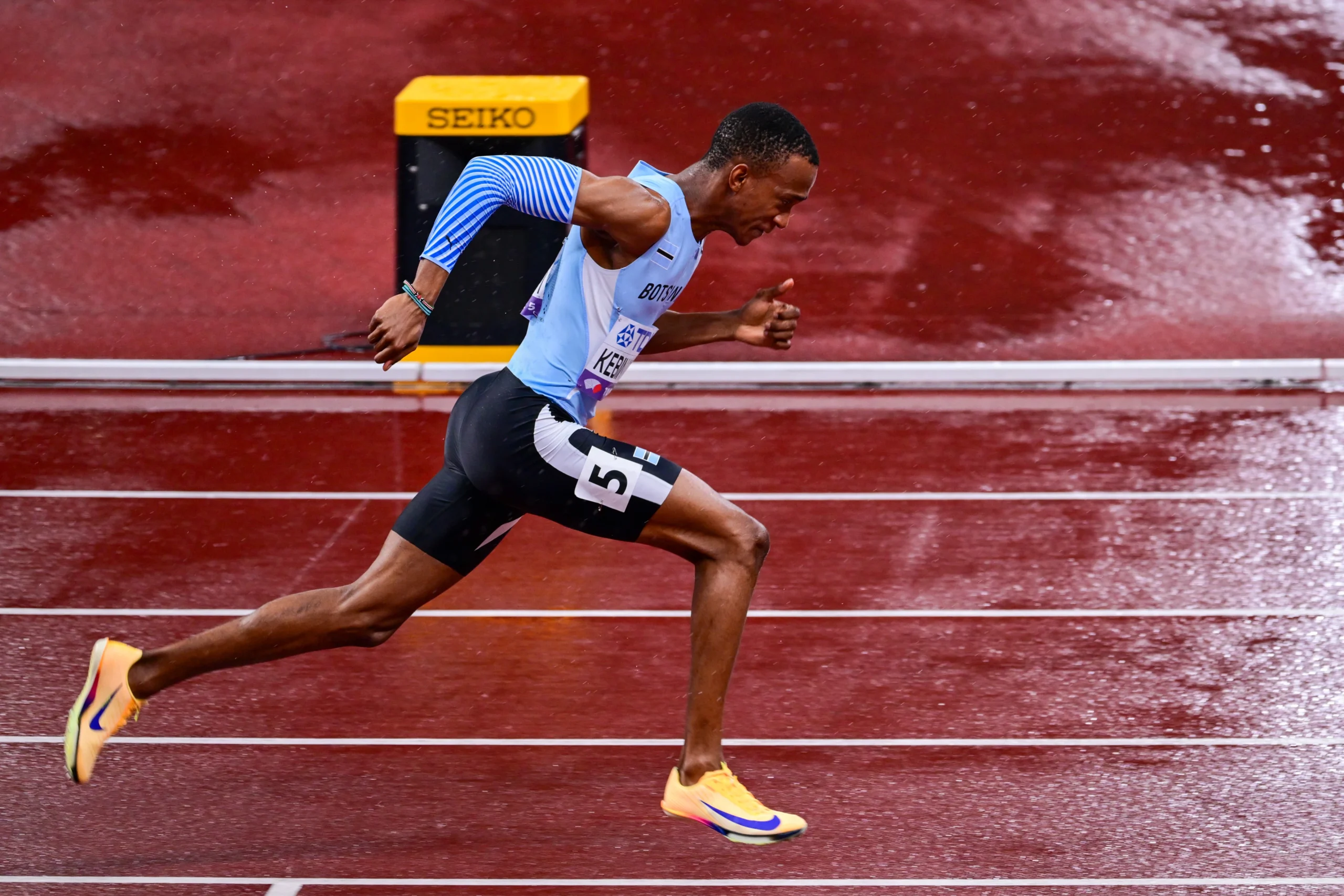
The featured photograph shows Busang Collen Kebinatshipi at the 2025 World Athletics Championships in Tokyo. The photograph is copyright © Erik van Leeuwen and was obtained from Wikimedia Commons.
It is published under the Creative Commons Attribution-ShareAlike 4.0 International licence . That licence permits sharing and adaptation, including commercial reuse, provided the photographer is credited, a link to the licence is supplied, changes are indicated and any adapted version is distributed under the same or a compatible licence.
Changes made by ITC International Running: the source image was resized, optimized and converted to WebP for web publication. No claim of ownership is made over the underlying photograph.