


Josh Kerr Breaks the Mile World Record: How His 1200m Simulation Predicted Project 222
3:42.66Josh Kerr has broken one of athletics’ most historic records. His reported 2:42.45 altitude 1200m simulation had already revealed the speed endurance, closing ability and belief required to turn Project 222 into mile history.
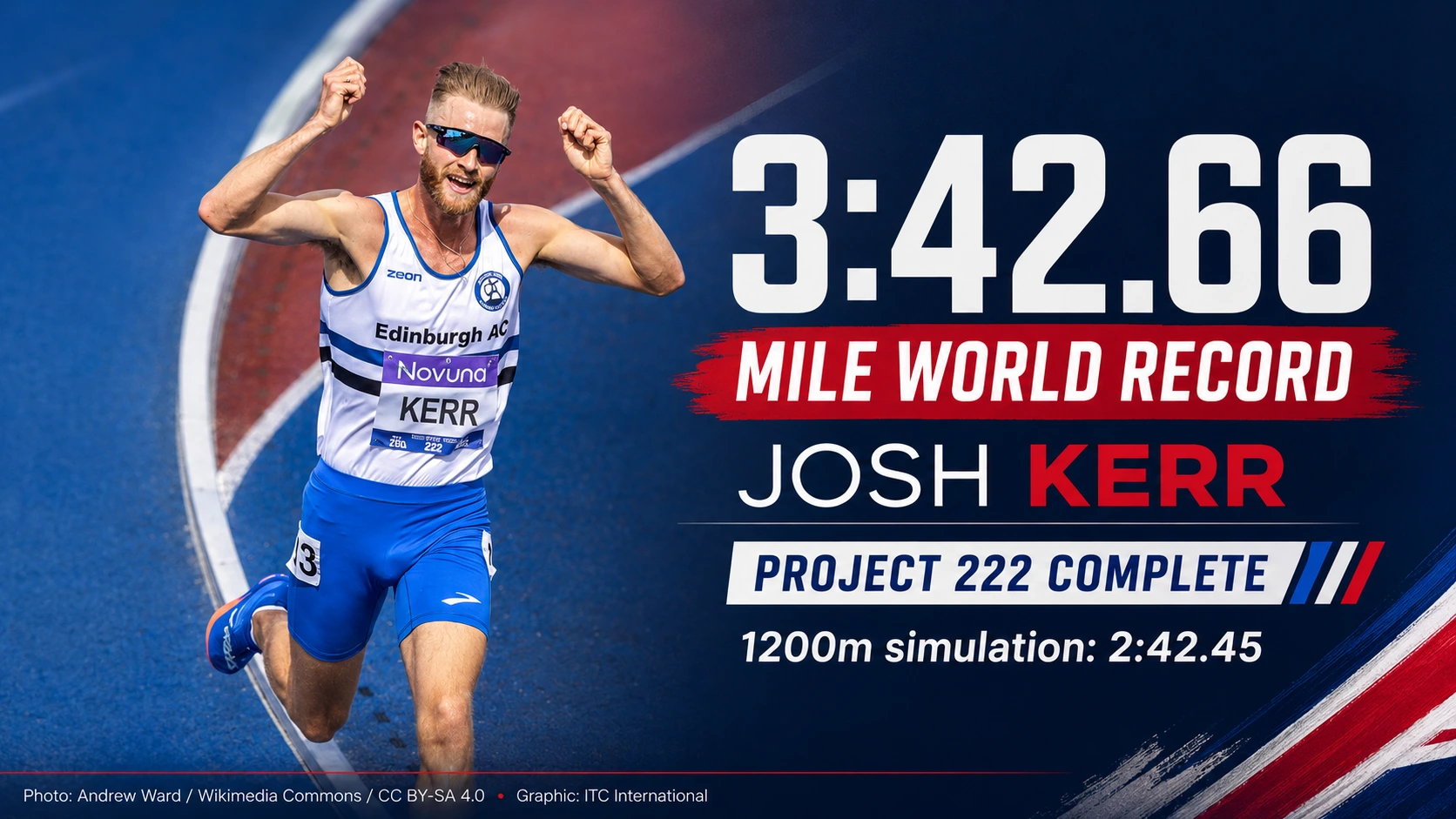
Josh Kerr celebrates completing Project 222 after breaking the men’s mile world record in 3:42.66 in London. Photo: Andrew Ward / Wikimedia Commons / CC BY-SA 4.0. Graphic: ITC International.
ITC International congratulates Josh Kerr, coach Danny Mackey, his training partners and the full Project 222 performance team. Kerr publicly committed to an exact target, shaped his season around it and delivered a men’s mile world record under enormous pressure in London.
On July 18, 2026, Josh Kerr produced the defining performance of Project 222, running the mile in 3:42.66 at the London Diamond League. The performance lowered Hicham El Guerrouj’s 3:43.13 world record from 1999 by 0.47 seconds and placed Kerr in one of the most exclusive lineages in track and field.
Project 222 referred to the objective of completing the mile in 222 seconds—3 minutes and 42 seconds. It gave the attempt a precise identity, made the goal understandable to a global audience and placed Kerr’s preparation under continuous public scrutiny.
Josh Kerr’s 1200m Simulation Was the Strongest Public Indicator
The most revealing training evidence before London was Kerr’s reported 1200-metre simulation in 2:42.45 at approximately 5,335 feet of elevation in Albuquerque, New Mexico. The session used pacing assistance and a running start, so it should not be treated as an official performance. Its coaching value, however, was substantial.
A race-specific training test that revealed Kerr’s rhythm, speed endurance, finishing ability and psychological readiness before the world-record attempt.
| Checkpoint | Reported split | ITC interpretation |
|---|---|---|
| 400m | 55.72 | Controlled opening near world-record mile rhythm |
| 800m | 1:50.57 | Maintained pace without excessive early commitment |
| 1000m | 2:16.70 | Arrived at the decisive section with speed still available |
| 1200m | 2:42.45 | Reported final 400m of 51.88 showed exceptional closing capacity |
Training-context note: this was a reported simulation using pacing and a running start. It was not an officially ratified race result. Its relevance lies in what it suggested about Kerr’s condition and readiness.
How the 1200m Simulation Connected to the Mile World Record
The simulation tested approximately three-quarters of the mile at altitude while allowing Kerr to demonstrate a powerful late acceleration.
London required an official standing start, the full 1609.34-metre distance, pacing transitions, crowd pressure and complete commitment through the final lap.
The simulation did not prove that Kerr would break the record. No single workout can guarantee a competition result. What it did provide was direct evidence that the required race rhythm was available and that he could accelerate after sustained work.
That is especially important for milers. World-record pace is not only an aerobic challenge. The athlete must remain technically composed, relaxed through the shoulders, stable through the hips and capable of recruiting more speed while lactate and respiratory distress rise sharply.
Why 1200m Simulations Work So Well for Milers and 1500m Runners
I have personally used similar 1200-metre simulations for 1500m and mile athletes, followed by short sharpening work after appropriate recovery. When prescribed at the right time, this is one of the best sessions for connecting race-specific fitness with belief.
- It covers enough distance to expose weaknesses in rhythm, posture, breathing and speed endurance.
- It finishes before reproducing the complete fatigue of the target race, reducing unnecessary recovery cost.
- It gives the athlete a measurable performance reference that can strengthen race-day confidence.
- A strong final 200–400 metres confirms that the athlete can change gears after sustained high-intensity running.
- Short sharpening repetitions afterward can preserve speed and mechanics without repeating the full metabolic demand.
The best 1200m simulation does not manufacture fitness. It reveals fitness—and gives the athlete the evidence needed to believe that the target pace can be carried into competition.
The Simulation Was a Major Morale Booster
The psychological value of Kerr’s session may have been just as important as the physiological data. Before the simulation, 3:42 was an objective. After the simulation, world-record rhythm had become a sensation his body had already experienced.
That changes the athlete’s internal conversation. When discomfort arrives during the third lap of the mile, the athlete is less likely to interpret it as failure. The pace is difficult, but it is familiar. The athlete has already rehearsed the posture, cadence and emotional commitment required to remain in the attempt.
For this reason, a well-executed simulation can become a major morale booster. The athlete leaves the session knowing that the preparation has produced a specific competitive capacity—not merely general fitness.
Short Sharpening After the Simulation
The training after a major simulation is crucial. Once the athlete has confirmed readiness, the objective should not be to repeatedly prove fitness through additional exhaustive workouts.
The better approach is to reduce volume while preserving high-quality speed, relaxation and mechanics. Short repetitions with full or generous recovery can reinforce cadence and finishing speed without recreating the fatigue of the 1200m effort.
- Preserve neuromuscular sharpness without adding excessive metabolic fatigue.
- Keep race pace feeling controlled and technically efficient.
- Allow glycogen, connective tissue and the nervous system to recover.
- Protect the positive psychological memory created by the successful simulation.
Project 222 Can Now Become Josh Kerr’s Lasting Brand
222 Has Become a Symbol, Not Just a Target
Before London, Project 222 was the name of a difficult attempt. After the world record, it became a completed promise. That gives the number lasting sporting, cultural and commercial value.
The strongest athlete brands are often built around an instantly recognizable idea. For Kerr, 222 now represents a precise ambition, public accountability, disciplined preparation and delivery under extreme pressure.
The authenticity of the brand is important. Project 222 was not created after Kerr became the record holder. The number was attached to the risk before the outcome was known. The public followed the preparation, understood the target and watched Kerr deliver it.
That is why 222 can continue beyond this single race. It can become part of Kerr’s visual identity, storytelling, future events and legacy in the same way that iconic numbers and phrases remain connected to historic sporting achievements.
What Coaches and Athletes Should Learn
Make the objective precise
Project 222 transformed a broad ambition into a measurable target. The athlete, coach, support team and public all understood exactly what success required.
Use simulation as confirmation
The 1200m session worked because it reflected the real demands of the mile. It was not an arbitrary time trial disconnected from the goal event.
Finish the simulation with quality
Kerr’s reported 51.88 final lap was especially meaningful because it suggested that speed remained available after two hard laps.
Sharpen rather than retest
Once readiness has been confirmed, the final phase should protect freshness, mechanics and confidence rather than repeatedly chase another maximum performance in training.
Let performance give the brand meaning
Project 222 now carries weight because Kerr fulfilled the sporting promise. The athletics came first, and the brand value followed.
ITC International congratulates Josh Kerr, Danny Mackey and the entire Project 222 team. The reported 2:42.45 altitude 1200m simulation showed that something historic was possible. Kerr’s execution in London transformed that possibility into a mile world record.
Sources and further reading
Training note: the 2:42.45 1200m was a reported altitude training simulation using pacing assistance and a running start. It is analyzed here as a coaching indicator, not presented as an official competition result.