


ITC Mile World Record Analysis
Josh Kerr Project 222: Why Hicham El Guerrouj’s Mile World Record May Survive
Josh Kerr has the speed, championship nerve and modern support required to make the attempt credible. But 222 seconds demands more than raw speed. It requires the aerobic power, running economy and fatigue resistance to preserve world-record velocity when the final lap becomes decisive.
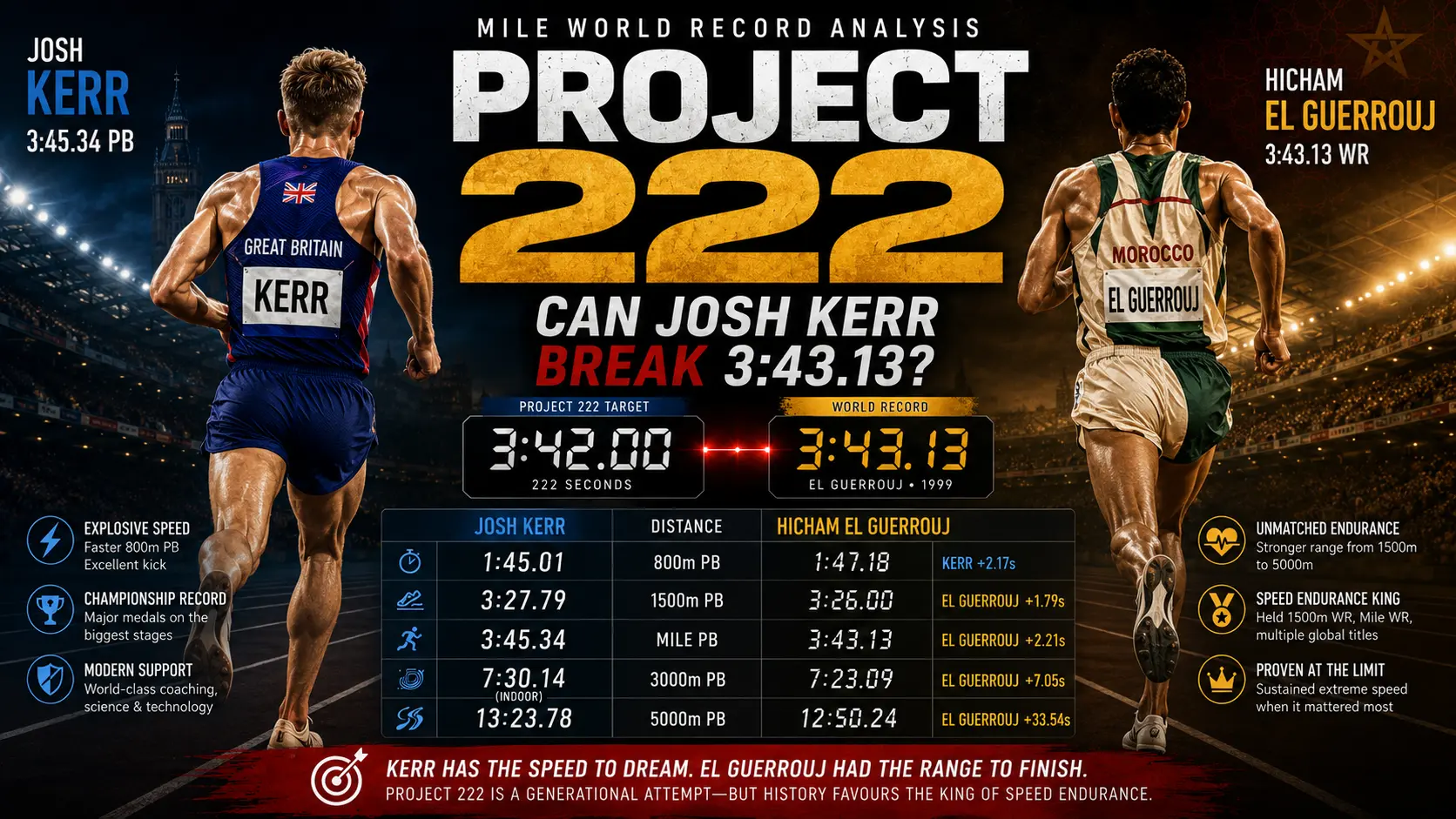
Performance comparison prepared only for ITC.International editorial analysis.
What Project 222 Actually Means
Project 222 is the promotional name attached to Josh Kerr’s attempt to run one mile in exactly 222 seconds: 3:42.00.
The number is memorable, marketable and easy for a global audience to understand. It creates a clean barrier in the same way that sub-four once defined the mile. But Project 222 is not simply the minimum required to break Hicham El Guerrouj’s world record.
El Guerrouj’s official mark is 3:43.13. A time of 3:43.12 would therefore be sufficient to set a new world record. Project 222 demands another 1.12 seconds beyond that minimum.
The world-record target begins at 3:43.12. The Project 222 target begins at 3:42.00.
The Percentage Argument: Why 3:42 Is an Enormous Personal Breakthrough
El Guerrouj lowered Noureddine Morceli’s 3:44.39 world record to 3:43.13, an improvement of 1.26 seconds, or approximately 0.562%.
A 3:42.00 mile would lower El Guerrouj’s record by 1.13 seconds, approximately 0.506%. Therefore, 3:42.00 would not represent a larger percentage improvement of the world record than El Guerrouj produced.
The more important comparison concerns Kerr’s own performance history. From a mile best of 3:45.34, he would need to improve by 2.22 seconds to run 3:43.12 and by 3.34 seconds to reach 3:42.00.
| Performance change | Seconds gained | Percentage improvement |
|---|---|---|
| Morceli 3:44.39 → El Guerrouj 3:43.13 | 1.26 | 0.562% |
| El Guerrouj 3:43.13 → proposed 3:42.00 | 1.13 | 0.506% |
| Kerr 3:45.34 → minimum record 3:43.12 | 2.22 | 0.985% |
| Kerr 3:45.34 → Project 222 target 3:42.00 | 3.34 | 1.482% |
At recreational level, a 1.48% improvement may look small. At the highest level of middle-distance running, where an athlete is already operating close to his demonstrated ceiling, it is enormous. Project 222 asks Kerr to improve his proven mile best by nearly three times the percentage by which 3:42 would improve the existing world record.
How Aerobic Is a One-Mile Race?
The mile is primarily an aerobic event. Research on the closely related 1500m generally estimates an aerobic contribution of approximately 75–85%, leaving about 15–25% anaerobic. The exact proportion varies by athlete, pacing pattern and measurement method.
Because the mile lasts longer than the 1500m, it is reasonable to describe it as roughly 80–85% aerobic. That does not make speed or anaerobic capacity unimportant. Those qualities support the start, pace changes, periods above maximal aerobic power and the final drive to the line.
El Guerrouj and Kerr: What Their Performances Actually Show
| Distance | Hicham El Guerrouj | Josh Kerr | Recorded advantage |
|---|---|---|---|
| 800m | 1:47.18 | 1:45.01 | Kerr by 2.17 seconds |
| 1500m | 3:26.00 | 3:27.79 | El Guerrouj by 1.79 seconds |
| Mile | 3:43.13 | 3:45.34 | El Guerrouj by 2.21 seconds |
The pattern is revealing. Kerr has the faster recorded 800m performance. El Guerrouj is faster over 1500m, and his advantage expands over the mile.
Race results cannot establish, by themselves, that one athlete had a larger laboratory-measured aerobic capacity or anaerobic capacity. Performance also depends on running economy, lactate dynamics, muscle recruitment, tactics, conditions, track technology, footwear and event-specific preparation.
What the record does show is that El Guerrouj demonstrated superior event-specific speed endurance. He preserved more velocity as the duration increased and the event became more heavily aerobic.
Did Kerr’s Faster 800m Prove Superior Anaerobic Capacity?
Kerr’s faster recorded 800m is a real asset. It suggests a larger speed reserve between his mile pace and his maximum middle-distance velocity.
It does not prove that his anaerobic capacity is definitively greater.
The 800m is itself substantially aerobic, and El Guerrouj did not build his career around that event. His listed 800m best was also recorded years before his peak mile performance. We therefore know that Kerr has the superior documented 800m result, but we cannot use those two race times to isolate either athlete’s physiology.
The more meaningful observation is that El Guerrouj could possess a slower recorded 800m while sustaining faster velocity over 1500m and the mile. His greatness was not based on an official 800m résumé. It was based on his ability to preserve extraordinary speed for nearly four minutes.
The Missing Evidence: What Do Their 3000m and 5000m Performances Show?
The strongest argument against Project 222 does not come from the 800m. It comes from what happens as the distance extends beyond the mile.
| Distance | Hicham El Guerrouj | Josh Kerr | Recorded difference |
|---|---|---|---|
| 1500m | 3:26.00 | 3:27.79 | El Guerrouj by 1.79 seconds |
| Mile | 3:43.13 | 3:45.34 | El Guerrouj by 2.21 seconds |
| 3000m | 7:23.09 | 7:30.14 short track | El Guerrouj by 7.05 seconds |
| 5000m | 12:50.24 | 13:23.78 | El Guerrouj by 33.54 seconds |
These figures must be interpreted carefully. Kerr has not built his career around the outdoor 3000m or 5000m, and his 13:23.78 dates from an earlier stage of his career. It would therefore be incorrect to treat that result as a precise measurement of his present aerobic ability.
Nevertheless, the contrast matters. El Guerrouj did not merely possess mile speed. His 7:23.09 for 3000m and 12:50.24 for 5000m showed that his performance quality extended deep into the aerobic end of the distance-running spectrum.
Kerr’s 7:30.14 short-track 3000m confirms elite endurance, and his championship record proves that he can defeat stronger time-trial runners tactically. What remains unproven is whether he possesses El Guerrouj’s combination of aerobic power, economy and fatigue resistance at an uninterrupted world-record pace.
Why Project 222 Is Genuinely Possible
1. Kerr’s 800m Speed Is a Real Asset
A runner with Kerr’s 800m speed has enough raw pace that 55–56-second laps are not equivalent to maximum sprinting. This matters because a miler with less speed may consume too much anaerobic reserve merely staying on target.
2. His 3:27.79 Confirms World-Class 1500m Ability
Kerr’s 1500m best places him among history’s fastest performers. It confirms that he can sustain velocity close to the level required for a world-record mile.
3. A Purpose-Built Race Removes Tactical Waste
A record attempt can use designated pacemakers, precise target splits, planned drafting and a field selected to maintain momentum. Every unnecessary surge, wide bend and extra metre has an energy cost.
4. Modern Equipment and Preparation Can Add Marginal Gains
Current racing shoes, track surfaces, altitude strategies, nutrition, strength training, sleep monitoring and recovery systems can each contribute small improvements. None guarantees a world record, but several marginal gains can matter when the target is measured in tenths of a second.
5. Kerr Has Demonstrated Competitive Courage
Kerr has repeatedly performed under championship pressure. A world-record attempt can fail psychologically before the final lap if the athlete becomes frightened by the early splits. Kerr’s competitive history suggests that he is willing to commit.
Why Project 222 Probably Will Not Succeed
1. Kerr Has Not Yet Run Close Enough to 3:42
A 3.34-second improvement at this level is enormous. Even breaking the world record by one hundredth would require a 2.22-second personal best.
2. El Guerrouj’s 1500m Evidence Is Stronger
El Guerrouj’s 3:26.00 remains 1.79 seconds faster than Kerr’s 3:27.79. Since the mile is predominantly aerobic, that difference matters. Kerr must maintain record-level velocity for another 109.344 metres after 1500m.
As an illustration, if Kerr reached 1500m in 3:27.79 during a 3:42.00 mile, he would have only 14.21 seconds to cover the remaining 109.344 metres. A real mile is paced differently, but the calculation demonstrates how little margin exists.
3. El Guerrouj’s Record Race Was Exceptionally Complete
El Guerrouj’s world record was not produced by fitness alone. It combined accurate pacemaking, strong competition and the ability to preserve mechanics and speed under maximal fatigue.
Noah Ngeny remained close enough to apply genuine pressure and also finished below the previous world record. A modern attempt requires similarly precise pacing and another athlete capable of carrying the race once the pacemakers step aside.
4. Faster 800m Speed Does Not Solve the Aerobic Problem
Kerr’s superior documented 800m speed helps him reach record pace. It does not guarantee that he can sustain that pace. Because roughly four-fifths of the mile’s energy demand is aerobic, speed reserve cannot indefinitely compensate for the metabolic cost of world-record velocity.
5. Project 222 May Encourage an Over-Ambitious Pace
A runner targeting 3:42.00 must pass the key points faster than a runner targeting 3:43.12. If 3:42 fitness is not fully present, following the campaign number could turn a possible record challenge into a severe final-lap collapse.
The smarter strategy may be to pace directly for the world record and allow 3:42 to emerge only if Kerr reaches the final lap with more reserve than expected.
6. The Record Has Already Survived Faster Recent Milers
Other modern athletes have run closer to El Guerrouj’s record than Kerr’s present 3:45.34. Their performances show that even reaching the 3:43 range does not guarantee the final fractions required to break 3:43.13.
7. World Records Require Perfect Conditions
Wind, temperature, imperfect drafting, track congestion, a momentary pacing error or a small mechanical decline can cost several tenths of a second. Project 222 requires the athlete and the entire race environment to align on one date.
Was El Guerrouj More Aerobic Than Kerr?
The honest answer is that public race results cannot establish this as a laboratory fact. Comparable peak-era measurements of maximal oxygen uptake, running economy, critical speed, lactate threshold, maximal accumulated oxygen deficit and anaerobic speed reserve would be needed.
What the record book establishes is narrower but still significant:
- El Guerrouj demonstrated faster 1500m performance.
- El Guerrouj demonstrated faster mile performance.
- El Guerrouj demonstrated stronger recorded 3000m and 5000m range.
- Kerr demonstrated faster recorded 800m performance.
- El Guerrouj lost less velocity as the duration increased.
That pattern is consistent with exceptional aerobic power, running economy and fatigue resistance, but it does not isolate the exact physiological cause.
Why Hicham El Guerrouj Was So Special
El Guerrouj did not simply produce one perfect mile. He ran 3:26.00 for 1500m, 3:43.13 for the mile, 7:23.09 for 3000m and 12:50.24 for 5000m.
His record profile demonstrated range without sacrificing peak speed. He could force a hard pace, maintain efficient mechanics and still close under pressure. His performances suggest that he combined nearly every requirement of the mile at once: aerobic power, economy, speed reserve, pace tolerance, concentration and competitive resilience.
The record has lasted not because modern athletes lack technology or courage. It has lasted because El Guerrouj’s performance sat at the intersection of exceptional speed and exceptional aerobic durability.
Final Verdict: Project 222 Is More Likely to Expose Kerr’s Aerobic Limit Than Break the Record
Josh Kerr has enough speed to make the attempt legitimate. His 1500m best of 3:27.79, mile best of 3:45.34, championship record and world-class 3000m ability mean that Project 222 cannot be dismissed as publicity alone.
But the decisive question is not whether Kerr can run fast enough for one lap, 800 metres or even 1200 metres. It is whether he can preserve approximately 55.5-second-lap velocity once the race has consumed most of his anaerobic reserve and the remaining work must be supported primarily by aerobic power, running economy and fatigue resistance.
That is where the available evidence continues to favour Hicham El Guerrouj.
El Guerrouj was faster over 1500m and the mile. Beyond those distances, his 3000m and 5000m performances supplied additional evidence of extraordinary aerobic range. Those marks do not provide a laboratory measurement of his physiology, but they demonstrate a breadth of sustained performance that Kerr has not yet matched publicly.
Kerr’s 3000m is world class, and his recorded 5000m is old and unlikely to represent his current fitness. It would therefore be unfair to say that he lacks aerobic capacity. The more precise conclusion is that he has not yet produced the same evidence of aerobic-range superiority and fatigue resistance as the athlete whose record he is attempting to break.
The mile world record is unlikely to fall.
Kerr’s raw speed should allow him to follow the required pace through the early and middle stages. The probable failure point is the final 400 metres, when speed reserve can no longer compensate for the aerobic cost of sustaining 3:42 pace.
A major personal best and a serious challenge to 3:43.13 are possible. But based on the available performance evidence, Project 222 asks Kerr to display a level of sustained aerobic speed that he has not yet demonstrated across the mile, 3000m or 5000m.
If Kerr succeeds, he will not merely have used superior speed to defeat El Guerrouj’s record. He will have produced new evidence that his aerobic power, economy and fatigue resistance were significantly greater than his previous race record revealed.
Frequently Asked Questions
Is Project 222 the same as breaking the mile world record?
No. El Guerrouj’s record is 3:43.13, so 3:43.12 would be enough. Project 222 targets 3:42.00, which is 1.12 seconds faster than the minimum required.
Is the mile more aerobic or anaerobic?
The mile is predominantly aerobic. Research on 1500m running generally estimates an aerobic contribution of roughly 75–85%, with the exact value depending on the athlete and methodology.
Does Kerr’s faster 800m prove better anaerobic capacity?
No. It proves that Kerr has the faster recorded 800m performance. It does not isolate anaerobic capacity because the 800m is itself substantially aerobic and El Guerrouj did not specialize in that event at his peak.
Why do the 3000m and 5000m performances matter?
They provide additional evidence of aerobic range and fatigue resistance. El Guerrouj’s superior marks strengthen the argument that his mile record was supported by more than raw speed.
Do Kerr’s slower 3000m and 5000m bests prove an aerobic weakness?
No. Kerr’s 5000m best is old and may not represent his current ability. The fair conclusion is that his public record does not yet show the same breadth of aerobic-range performance as El Guerrouj’s.
What is the most likely failure point in Project 222?
The final 400 metres. Kerr may have sufficient speed to follow the required early pace, but the decisive test is whether he can preserve that speed after the aerobic and metabolic cost has accumulated.
Sources and Further Reading
- World Athletics: Hicham El Guerrouj athlete profile
- World Athletics: Josh Kerr athlete profile
- World Athletics: men’s all-time outdoor mile list
- World Athletics: El Guerrouj’s 1999 mile world-record report
- Spencer and Gastin: energy-system contribution during 200m–1500m running
- Review of 800m and 1500m energy-system demands