


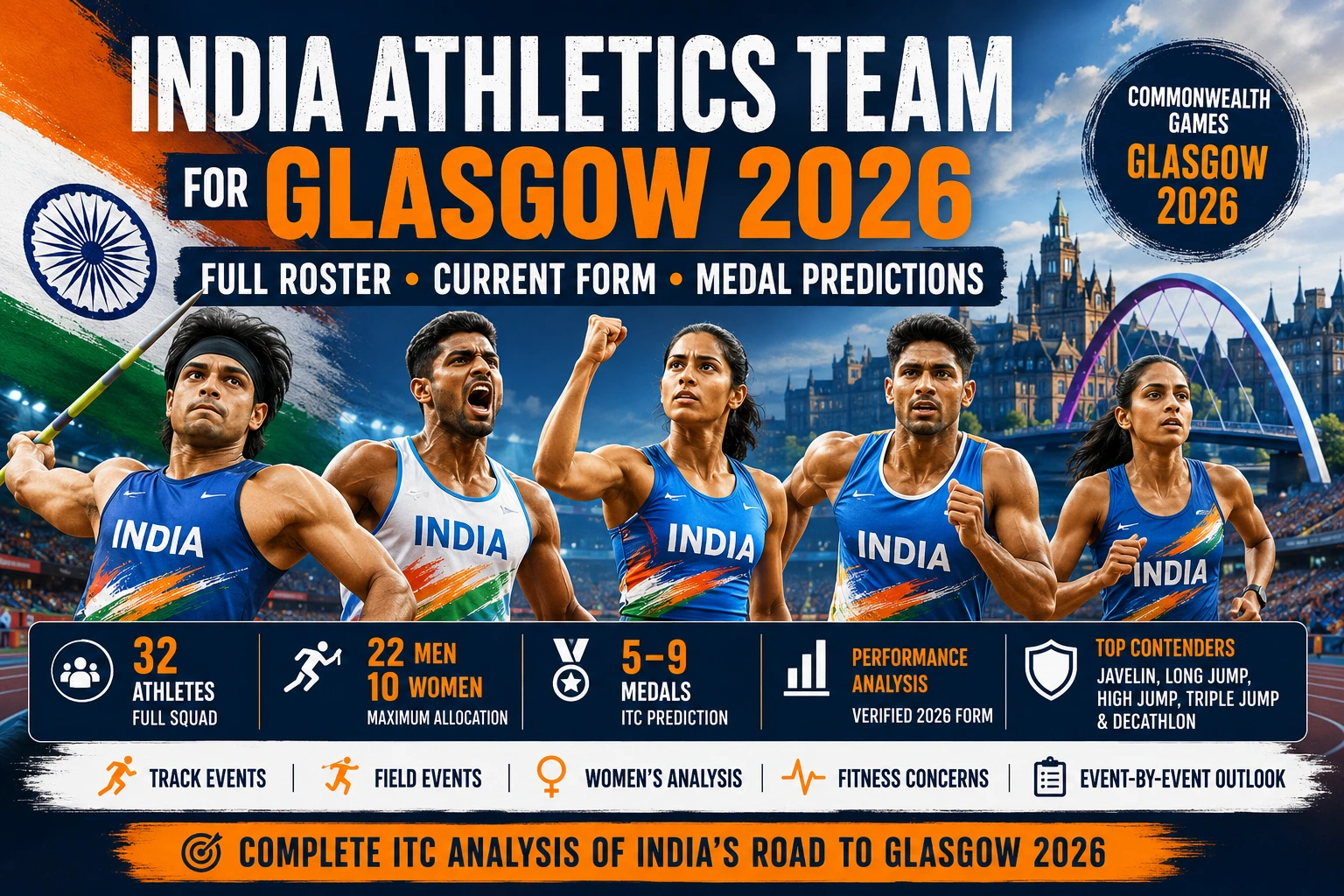
India Athletics Team for Glasgow 2026: Full Roster, Current Form and Medal Predictions
India has selected a 32-member track and field squad for the Glasgow 2026 Commonwealth Games. ITC examines every selection, the strongest 2026 performances, fitness concerns, medal opportunities and the events in which expectations must remain realistic.
India’s full athletics roster for Glasgow 2026
The Athletics Federation of India announced a maximum-size squad of 32 athletes. It contains 22 men and 10 women, with multiple selections in events where AFI appears to believe India could place more than one athlete in the final or medal positions.
Men — 22 athletes
- Gurindervir Singh100m
- Animesh Kujur200m
- Gulveer Singh5000m and 10,000m
- Tejas Ashok Shirse110m hurdles
- Yashas P400m hurdles
- Santhosh Kumar Tamilarasan400m hurdles
- Sarvesh Anil KushareHigh jump
- Aadarsh Ram JHigh jump
- Dev MeenaPole vault
- Kuldeep KumarPole vault
- Murali SreeshankarLong jump
- Lokesh SathyanathanLong jump
- Praveen ChithravelTriple jump
- Selva PrabhuTriple jump
- Samardeep Singh GillShot put
- Tajinderpal Singh ToorShot put
- Neeraj ChopraJavelin throw
- Rohit YadavJavelin throw
- Yash Vir SinghJavelin throw
- Tejaswin ShankarDecathlon and high jump
- Vishal TK400m and mixed 4×400m
- Rajesh Ramesh400m and mixed 4×400m
Women — 10 athletes
- Parul Chaudhary3000m steeplechase and 5000m
- PoojaHigh jump
- Manpreet KaurShot put
- SeemaDiscus throw
- Nidhi RaniDiscus throw
- Ravina10,000m race walk
- Priyanka10,000m race walk
- Ansa BabuMixed 4×400m relay pool
- Rashdeep KaurMixed 4×400m relay pool
- Neeru PathakMixed 4×400m relay pool
Selection process: a strong team with unanswered procedural questions
AFI stated that the national team was selected under its Commonwealth Games policy and that India could enter a maximum of 32 track and field athletes. The federation ultimately selected the full allocation.
One issue deserves transparent reporting. The published qualification guidelines referred to an allocation of 16 men and 16 women, but the announced roster contains 22 men and 10 women. The overall number remains 32, although the publicly available sources reviewed for this article did not explain how or why the gender distribution was changed.
Conditional selections
AFI initially attached conditions to two major selections:
- Neeraj Chopra was required to achieve AFI’s 82.61m qualification mark after recovering from what the federation described as a niggle.
- Selva Prabhu was required to demonstrate fitness and produce a performance close to the 16.89m triple-jump standard at the subsequent Bhubaneswar competition.
Selva later jumped 16.79m in the Inter-State final and completed a competitive series, providing meaningful evidence that he had returned to a usable competitive level.
India athlete performance audit
The following table combines verified 2026 marks found in official AFI material with an event-based assessment. A season best does not automatically make an athlete a medal favourite. Consistency, recent results, injury history, championship reliability and the final Glasgow field all matter.
| Athlete | Event | Verified 2026 evidence | Form interpretation | ITC category |
|---|---|---|---|---|
| Murali Sreeshankar | Long jump | 8.38m with a −0.8 m/s wind | Elite championship performance and one of India’s strongest current results. | Gold-to-bronze range |
| Sarvesh Kushare | High jump | 2.31m Indian record | World-class peak clearance with strong medal implications. | Gold-to-bronze range |
| Rohit Yadav | Javelin | 87.05m | Exceptional ceiling, although the earlier rounds show the level was not repeated across the full series. | Gold-to-bronze range |
| Neeraj Chopra | Javelin | Initially selected conditionally after a reported niggle | Championship history is exceptional, but current fitness and competition volume remain relevant. | Leading contender |
| Praveen Chithravel | Triple jump | 16.92m | Strong winning mark and capable of entering the Commonwealth medal discussion. | Podium contender |
| Selva Prabhu | Triple jump | 16.79m | Completed a competitive series after facing a fitness condition. | Finalist with medal upside |
| Pooja | High jump | 1.93m earlier in 2026; 1.83m in June | Medal-level peak but less convincing recent domestic form. | Podium contender |
| Tejaswin Shankar | Decathlon | 8057 points listed as the Indian record | Internationally competitive total; the high-jump double may affect recovery. | Podium contender |
| Aadarsh Ram | High jump | 2.25m | Strong finalist-level mark, but below Sarvesh’s current ceiling. | Finalist with medal upside |
| Yash Vir Singh | Javelin | 83.72m | Internationally credible mark; podium prospects depend heavily on the final field. | Outside bronze chance |
| Samardeep Singh Gill | Shot put | 20.40m | Multiple throws around or beyond 20m demonstrate useful consistency. | Likely finalist |
| Tajinderpal Singh Toor | Shot put | 20.27m | Stable 20m-level form, although likely medal standards may be higher. | Likely finalist |
| Vishal TK | 400m | 44.98 Indian record; 45.43 in June | Outstanding domestic progression and legitimate final potential. | Finalist with medal upside |
| Rajesh Ramesh | 400m | 45.91 in June | Important relay value; individual medal standard remains demanding. | Individual medal unlikely |
| Yashas P | 400m hurdles | 49.14 | Strong Indian performance and possible Commonwealth finalist. | Final candidate |
| Santhosh Kumar Tamilarasan | 400m hurdles | 49.14 | Effectively level with Yashas in the domestic final. | Final candidate |
| Tejas Ashok Shirse | 110m hurdles | 13.27 national record; 13.61 in June | High ceiling, but his follow-up result was less competitive than his peak. | Final possibility |
| Animesh Kujur | 200m | 20.74 into a −1.8 m/s headwind | The performance was stronger than the raw time suggests. | Semifinal or final possibility |
| Gurindervir Singh | 100m | 10.09 Indian record listed in AFI results | Historic Indian speed, but his absence from the June final creates a readiness question. | Readiness uncertain |
| Dev Meena | Pole vault | 5.46m | National-record-level progress; a final is more realistic than a medal forecast. | Finalist with outside chance |
| Kuldeep Kumar | Pole vault | 5.45m earlier; 5.20m in June | Strong season peak but weaker follow-up form. | Outside medal chance |
| Gulveer Singh | 5000m and 10,000m | 13:03.93 national record listed; 13:52.92 domestic win | Strong Indian record-holder facing deep Commonwealth opposition. | Finalist with tactical upside |
| Parul Chaudhary | Steeplechase and 5000m | Did not start the domestic steeplechase final | International ability is established, but current form and double-event readiness require context. | Provisional medal outsider |
| Ravina | 10,000m race walk | 1:39:15 road best listed; 1:48:56 in June | Latest performance creates a significant form concern; road and track events are not directly comparable. | Low-confidence assessment |
India’s strongest Glasgow 2026 medal events
Men’s long jump: Murali Sreeshankar returns to medal-level form
Sreeshankar’s 8.38m is one of the most persuasive performances anywhere on India’s roster. It was legal, produced in a domestic championship final and accompanied by evidence that he could repeatedly compete around the eight-metre level.
This is particularly important after injury interruptions previously complicated his progression. He is not being projected from an old personal best or reputation alone. He has produced a current championship-level result.
Men’s high jump: Sarvesh Kushare has entered a new performance level
Sarvesh cleared 2.31m after surviving pressure at 2.27m and then improving again. That attempt sequence matters in high jump because championship medals are often determined by first-attempt clearances, resilience and the ability to respond after a miss.
Aadarsh Ram’s 2.25m also gives India a second credible finalist. Tejaswin Shankar adds further depth, although his proposed high-jump and decathlon double could create a demanding competition schedule.
Men’s javelin: three selections and several medal scenarios
India selected Neeraj Chopra, Rohit Yadav and Yash Vir Singh. It is the clearest example of AFI using multiple entries in an event where the country could realistically place more than one athlete near the front.
Rohit Yadav’s 87.05m in context
Rohit’s winning series was reported as: 77.71m, 77.63m, foul, 77.51m, 79.40m and 87.05m.
The final throw was elite. The earlier rounds show that the same performance level was not repeated throughout the competition, but the winning mark still demonstrates an exceptional ceiling and the ability to produce under pressure.
Neeraj Chopra’s championship value
Neeraj’s greatest advantage is not simply distance. It is his record of producing under major-championship pressure. However, AFI originally made his selection conditional after a reported niggle, making current fitness and competition volume legitimate analytical questions.
Yash Vir Singh’s position
Yash Vir’s 83.72m gives India a third credible international-level entry. He is less secure as a medal prediction, but he cannot be dismissed if qualification is modest or major rivals fail to reproduce their season-best form.
Men’s triple jump: Praveen Chithravel and Selva Prabhu
Praveen won the Inter-State final at 16.92m. Selva reached 16.79m and produced additional legal jumps around 16.50m, which is important because it demonstrates competitive stability after his fitness had been questioned during selection.
Praveen has the stronger immediate medal case. Selva has the ability to reach the final and enter the bronze discussion, although a medal may require a jump closer to or beyond 17 metres.
Men’s decathlon: Tejaswin Shankar could become a major medal factor
AFI’s official results list Tejaswin’s Indian record at 8057 points. That total is internationally respectable and puts him in the Commonwealth medal conversation.
The important complication is his potential high-jump double. A decathlon already requires ten events over two days. Additional high-jump rounds could affect recovery, technical sharpness and overall energy management.
Track analysis: strong Indian progress, but deeper Commonwealth competition
Men’s 400m
Vishal TK’s 44.98 Indian record is a major breakthrough. He followed it with 45.43 at the Inter-State Championships, showing that the national record was not completely isolated from his broader form.
The difficulty is the depth of Commonwealth one-lap running. Botswana, South Africa, Canada, Zambia, England and Jamaica can produce athletes capable of running below 45 seconds or repeatedly near that level.
Men’s 400m hurdles
Yashas P and Santhosh Kumar Tamilarasan both ran 49.14 in the domestic final, separated by only a few thousandths of a second. That makes them credible candidates to advance through the rounds.
A Commonwealth medal may require a performance below 49 seconds, depending on the strength of the final field.
Men’s 110m hurdles
Tejas Ashok Shirse’s 13.27 national record reveals a high ceiling. His 13.61 result in June was still enough to win domestically but represents a noticeable decline from his peak.
He is capable of reaching a final if he returns closer to his record form.
Men’s 100m and 200m
Gurindervir Singh’s 10.09 national record is historically significant for Indian sprinting. However, he did not appear in the June 100m final result, meaning his latest readiness cannot be judged solely from the record.
Animesh Kujur’s 20.74 in the 200m was achieved into a 1.8 m/s headwind. The conditions make the performance better than the raw time indicates.
Men’s 5000m and 10,000m
Gulveer Singh is one of India’s strongest distance runners, with a national record of 13:03.93 listed for 5000m. He won the domestic championship in a slower tactical race.
His challenge is the extraordinary Commonwealth depth supplied by Kenya, Uganda, England, Australia, Canada, Scotland and other strong distance programs.
Mixed 4×400m relay
India’s relay pool includes Vishal TK, Rajesh Ramesh, Ansa Babu, Rashdeep Kaur and Neeru Pathak. Vishal’s breakthrough gives the team a strong men’s leg, but relay success depends on all four legs, baton execution, team order and athlete availability.
India can reach the final and challenge established teams, but it should not be listed as the clear favourite before final relay lineups are confirmed.
India women’s team: smaller roster, selective opportunities
Pooja — women’s high jump
Pooja’s 1.93m Indian record moved her into legitimate international medal territory. Her June championship performance of 1.83m was less convincing, with three misses at 1.86m.
This does not eliminate her medal prospects. High jump can fluctuate from competition to competition. It does mean she should be called a podium contender rather than an automatic gold favourite.
Parul Chaudhary — steeplechase and 5000m
Parul’s international experience, endurance and ability to handle championship races make her one of the most important women on the team. However, she did not start the domestic steeplechase final reviewed for this analysis.
A DNS does not establish an injury. She may have had an exemption, international schedule or planned competition strategy. Her latest form should therefore be verified through international results.
Women’s race walk
Ravina and Priyanka are selected for the 10,000m track walk. Care is required when interpreting their form because road half-marathon walk results cannot be directly converted into a 10,000m track prediction.
Ravina’s June half-marathon result was significantly slower than the national-record time listed beside the event. That creates a current-form concern.
Women’s shot put and discus
Manpreet Kaur, Seema and Nidhi Rani give India experienced representation in the throws. Their immediate objective should be qualification for the final, with medals likely requiring season-best performances.
Major fitness, readiness and consistency concerns
- Neeraj Chopra: initially selected conditionally following a reported niggle.
- Gurindervir Singh: national-record speed but absent from the June 100m final result.
- Pooja: 1.93m peak followed by a 1.83m domestic performance.
- Rohit Yadav: elite 87.05m throw but limited repetition near that distance.
- Kuldeep Kumar: strong season best followed by a lower June result.
- Ravina: recent half-marathon walk substantially slower than the listed national record.
- Parul Chaudhary: domestic steeplechase DNS requiring context.
- Tejaswin Shankar: possible fatigue and scheduling effects from attempting two demanding events.
ITC’s India athletics medal prediction for Glasgow 2026
Gold projection
1–3India’s most realistic gold routes are men’s javelin, men’s long jump and men’s high jump.
Total medals
5–9This range allows for medals in the jumps, javelin, decathlon and one additional breakthrough event.
Central forecast
7Approximately seven medals represents the most balanced prediction before final start lists are known.
India’s leading gold opportunities
- Murali Sreeshankar — men’s long jump
- Sarvesh Kushare — men’s high jump
- Neeraj Chopra — men’s javelin
- Rohit Yadav — men’s javelin
Realistic additional podium contenders
- Pooja — women’s high jump
- Praveen Chithravel — men’s triple jump
- Tejaswin Shankar — men’s decathlon
- Yash Vir Singh — men’s javelin
- Selva Prabhu — men’s triple jump
- Aadarsh Ram — men’s high jump
Potential finalists with medal upside
- Vishal TK — men’s 400m
- Yashas P — men’s 400m hurdles
- Santhosh Kumar Tamilarasan — men’s 400m hurdles
- Tejas Ashok Shirse — men’s 110m hurdles
- Dev Meena — men’s pole vault
- Samardeep Singh Gill — men’s shot put
- Tajinderpal Singh Toor — men’s shot put
- Gulveer Singh — men’s 5000m and 10,000m
- Parul Chaudhary — women’s steeplechase and 5000m
What would make Glasgow successful for India?
Success should not be judged only by the final medal total. This Glasgow team contains athletes at very different stages of development.
A strong overall performance would include:
- At least one gold medal from men’s long jump, high jump or javelin.
- Multiple medals across the men’s field events.
- Final appearances from India’s developing sprinters and hurdlers.
- A competitive women’s high-jump performance from Pooja.
- Evidence that national records can be converted into international championship success.
- Strong technical execution in the mixed 4×400m relay.
India’s long-term athletics progress will be better measured by depth and repeatability than by one extraordinary throw or jump. Glasgow offers an important test of whether recent national records can be converted into international finals and medals.
Frequently asked questions
How many Indian athletes were selected for Glasgow 2026 athletics?
AFI selected 32 athletes: 22 men and 10 women.
Who are India’s best athletics medal prospects?
Murali Sreeshankar, Sarvesh Kushare, Neeraj Chopra and Rohit Yadav appear to be India’s strongest gold-to-bronze prospects. Pooja, Praveen Chithravel and Tejaswin Shankar are also realistic podium contenders.
Can India win multiple medals in men’s javelin?
Yes. India selected Neeraj Chopra, Rohit Yadav and Yash Vir Singh. One or two medals are realistic, while a clean sweep would require an exceptional result.
Why is Murali Sreeshankar considered a gold contender?
His verified 8.38m legal jump represents elite current form. It was produced in a championship competition rather than being based only on an older personal best.
What is ITC’s projected Indian athletics medal total?
ITC projects approximately five to nine medals, with seven as the central forecast and one to three possible gold medals.
Will the medal forecast change?
Yes. It should be updated when complete event entries, withdrawals and official start lists are confirmed.
This analysis will require a final-entry update
In the next stage we will compare each Indian athlete with competitors officially entered in the same Glasgow event. World rankings and Commonwealth season lists may include athletes who are injured, not selected or competing in another event.
Future updates would include:
- The best confirmed Glasgow entrant in each event.
- The likely bronze-medal performance level.
- Late injuries and withdrawals.
- Qualification-round standards.
- Schedule conflicts affecting doubles.
- Revised medal probabilities.
Official sources
Editorial note: Medal predictions are analytical estimates, not guarantees. Results, injuries, team changes, event entries and withdrawals may alter the competitive outlook. ITC will update this article when complete official Glasgow start lists become available.