


India FIFA U-15 World Cup 2026: Qualification Rules, Format, Squad and Prospects
India can participate in FIFA’s inaugural U-15 World Cup & Festival through a new global entry system that does not require a traditional AFC qualifying tournament. Here is what FIFA has officially confirmed, what remains unknown and what the opportunity could mean for Indian youth football.

What is the FIFA U-15 World Cup & Festival?
The FIFA U-15 World Cup & Festival is a new international development competition intended to give young players access to global football before the established U-17 level.
FIFA approved the festival-style program in December 2025. The first competition will feature boys’ teams in 2026. A girls’ edition is planned for 2027. From 2028 onward, FIFA intends to organize separate annual boys’ and girls’ U-15 festivals and create participation opportunities for all 211 member associations.
This is fundamentally different from the FIFA U-17 World Cup, where countries normally progress through confederation championships and only a limited number of teams reach the finals.
Boys’ tournament
Azerbaijan will host the inaugural edition for boys’ U-15 national teams.
Girls’ tournament
FIFA plans to stage the next edition for girls’ U-15 national teams.
Annual boys and girls festivals
FIFA plans two separate annual events with participation opportunities for all member associations.
Did India qualify for the FIFA U-15 World Cup 2026?
India did not have to win a conventional qualifying tournament. FIFA has described the first edition as open to boys’ teams from all FIFA member associations.
India’s pathway is therefore based on FIFA membership and the association’s participation and registration process, rather than results in an AFC qualification competition.
The phrase “India qualified” may be used informally to celebrate India’s inclusion, but it can create the false impression that India defeated regional opponents to earn a limited finals place.
Does open participation mean there are no requirements?
No. Open eligibility does not remove the need for formal registration. AIFF and every other participating association will still have to satisfy FIFA’s eventual competition regulations.
These regulations are expected to address matters such as player eligibility, nationality, proof of age, squad registration, safeguarding, medical requirements and accreditation. The complete public regulations were not available in the official material reviewed for this article, so exact requirements should not be invented.
How will countries enter the tournament?
| Entry question | Current official position | Status |
|---|---|---|
| Is there an AFC qualifier? | No traditional AFC qualifying tournament has been announced for the inaugural edition. | No qualifier announced |
| Is a FIFA ranking needed? | No U-15 ranking or performance threshold has been announced. | No ranking standard |
| Who can enter? | FIFA says the first boys’ edition is open to teams from all FIFA member associations. | Open model |
| Is every eligible country guaranteed to attend? | Eligibility and an official final list of participating teams are not necessarily the same thing. | Final list pending |
| Has AIFF published India’s squad? | A complete official squad was not located in AIFF’s public material when this article was prepared. | Awaiting AIFF |
| Are exact age rules public? | The final birth-date cut-off and player-registration rules require confirmation in FIFA’s competition regulations. | Regulations pending |
This distinction is important. FIFA has opened the pathway to all member associations, but the final number of participating teams may depend on official entries, logistical arrangements and FIFA’s final operational structure.
FIFA U-15 World Cup 2026 format
FIFA has confirmed that the tournament will use an age-appropriate format rather than simply copying senior 11-a-side football.
- Matches will be shorter than standard senior international matches.
- Games will be played on smaller pitches.
- Teams will use between seven and nine players per side.
- The competition will combine a World Cup identity with a festival-style development environment.
Why smaller-sided football matters
Smaller-sided football normally gives each player more touches, more one-versus-one situations and more opportunities to make decisions under pressure.
This can reward players who scan quickly, control the ball in tight spaces, combine with teammates and change between attacking and defensive roles.
What FIFA has not yet published
Competition structure
- Final number of participating teams
- Number and size of groups
- Draw and seeding system
- Knockout or placement structure
- Number of guaranteed matches
- Method for ranking teams
Match regulations
- Exact match duration
- Exact pitch dimensions
- Whether games are seven-, eight- or nine-a-side
- Substitution rules
- Final squad size
- Goal and equipment dimensions
- Disciplinary regulations
Where and when will the FIFA U-15 World Cup take place?
FIFA has appointed Azerbaijan as host of the inaugural competition. The tournament is scheduled to run from 22 to 31 October 2026.
FIFA cited Azerbaijan’s sporting infrastructure in its announcement. The country has also been appointed to co-host the FIFA U-20 World Cup in 2027, giving the two events a degree of organizational continuity.
FIFA had not published a complete public list of U-15 stadiums, training grounds or host cities in the material reviewed for this article.
India U-15 squad: player names, states and villages
India’s complete FIFA U-15 World Cup squad had not been officially published by the All India Football Federation in the public sources reviewed for this article.
Until AIFF releases a national camp list or final registered squad, websites should not fill the gap with academy prospects, social-media rumours or players selected for unrelated age-group tournaments.
| Player | Position | State | District or village | Club or academy | Status |
|---|---|---|---|---|---|
| Official India U-15 national-team squad awaiting AIFF publication. | Update pending | ||||
What the final squad table should include
- Every player’s complete registered name
- Primary playing position
- Secondary position where relevant
- State football association
- District, town or village where reliably reported
- Current academy, club or school
- Recent national and youth-league performances
- Head coach and technical staff
- Pre-tournament camps and international friendlies
How should India select its U-15 team?
The smaller-sided format changes the type of player India may need. A strong conventional centre-back or target forward may not automatically be the best option in a seven- to nine-a-side tournament.
State championships
State and national youth competitions can uncover players outside professional academies and major cities.
Club youth leagues
Academy and league performances help selectors evaluate consistency rather than relying on one short trial.
National camps
Camps allow coaches to assess technical quality, tactical awareness, maturity, documentation and adaptability.
Selection qualities that may matter most
- First touch under pressure
- Quick scanning before receiving the ball
- Passing and combination play in tight areas
- One-versus-one attacking
- One-versus-one defending
- Position flexibility
- Rapid defensive transition
- Composure in possession
- Emotional maturity
- Ability to travel and adapt internationally
India should avoid selecting players only because they are physically advanced for their age. At U-15, biological maturity varies greatly. The goal should be to identify players with genuine technical and long-term potential.
What are India’s prospects at the FIFA U-15 World Cup?
India’s chances cannot yet be projected precisely because there is no established FIFA U-15 ranking, no final draw, no complete participant list and no confirmed India squad.
Reasons for optimism
- India has one of the world’s largest youth populations.
- Professional clubs are investing more in youth academies.
- State competitions create access to a broad scouting pool.
- Smaller-sided football may reward individual technique and creativity.
- India gains global experience without first surviving a difficult AFC qualification route.
- The tournament can identify players earlier in their development.
Reasons for caution
- Leading football nations have deeper academy systems.
- Many opponents provide far more high-quality youth matches.
- India’s final selection and preparation plan remain unknown.
- Short preparation could affect tactical organization.
- Physical-maturity differences can strongly influence U-15 games.
- One tournament cannot replace a sustainable development pathway.
India’s previous FIFA youth World Cup experience
India’s most prominent previous appearance at a FIFA youth World Cup came in 2017, when the country hosted the FIFA U-17 World Cup.
India played the United States, Colombia and Ghana. The team did not advance from its group, but Jeakson Singh’s goal against Colombia became the first goal scored by an Indian player at a FIFA World Cup tournament.
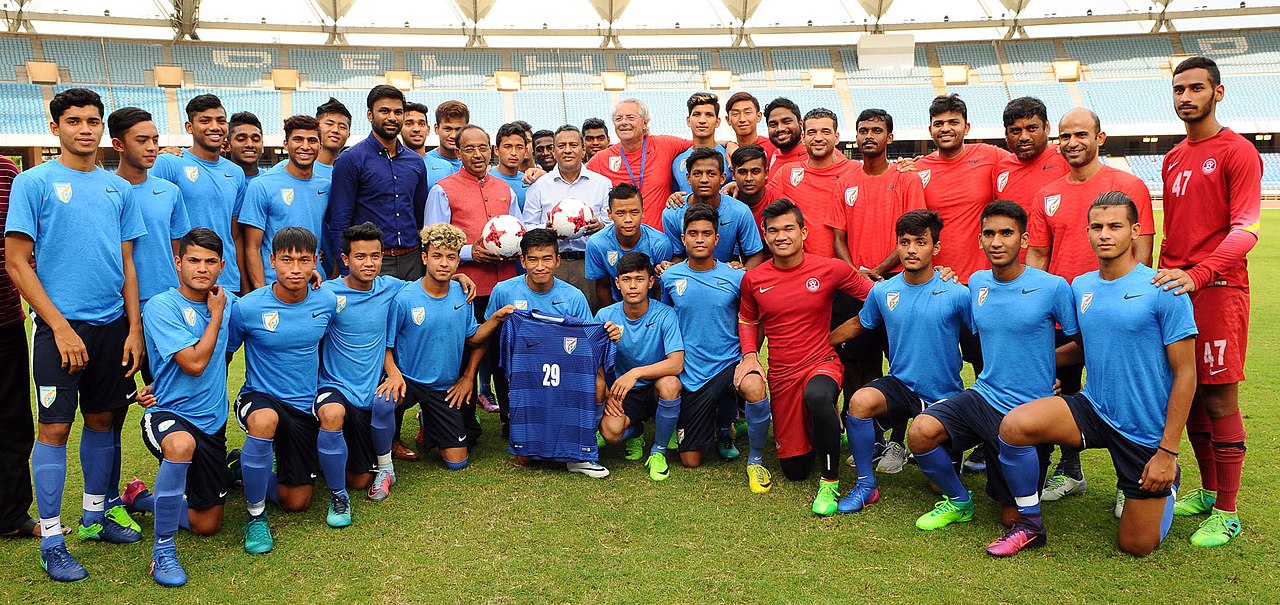
The lesson from 2017 is that tournament participation must lead to continued development. Players require regular club football, international exposure, education support and a clear progression path after the event.
Rurka Kalan’s historic 2010 Street Child World Cup title
India already has an extraordinary international youth-football story through Youth Football Club Rurka Kalan and its connection with the Khalsa Football Academy.
The inaugural Street Child World Cup was held in Durban, South Africa, in March 2010. India’s team was connected with the Rurka Kalan football program in Punjab and defeated Tanzania 1–0 in the final.
The event combined seven-a-side football with arts, cultural exchange and advocacy related to the rights of street-connected and marginalized young people.
The Street Child World Cup is not an official FIFA national-team competition. Its sporting and social significance should nevertheless be recognized as part of India’s international youth-football history.
Rurka Kalan finished runner-up at the 2026 Street Child World Cup
Sixteen years after the 2010 title, Youth Football Club Rurka Kalan again represented India at the Street Child World Cup, held in Mexico in May 2026.
India reached the boys’ Cup final and finished runner-up after a 4–2 defeat to Brazil. The fifth edition brought together 28 teams representing more than 20 countries and combined football with workshops and advocacy for street-connected young people.
Published reporting identified the Indian team as players from rural Punjab connected with YFC Rurka Kalan.
Reported Rurka Kalan players
| Player | Reported role | Origin information available |
|---|---|---|
| Silas Sidhu | Squad member | Punjab; exact village requires reliable confirmation |
| Arshdeep | Squad member | Punjab; exact village requires reliable confirmation |
| Jashanpreet | Squad member | Punjab; exact village requires reliable confirmation |
| Rajan Jakhu | Squad member | Punjab; exact village requires reliable confirmation |
| Sameer | Squad member | Punjab; exact village requires reliable confirmation |
| Raminder Singh | Squad member | Sri Muktsar Sahib, Punjab, according to published reporting |
| Sam Masih | Squad member | Punjab; exact village requires reliable confirmation |
| Shamsher Singh Akash | Goalkeeper | Punjab; exact village requires reliable confirmation |
Reported staff
- Anwar Ali — coach
- Harsh Jaisukh Chotaliya — team leader
- Nupur Nag — manager
The FIFA U-15 event and Street Child World Cup are different
| Feature | FIFA U-15 World Cup & Festival | Street Child World Cup |
|---|---|---|
| Organizer | FIFA | Street Child United |
| Team pathway | National football associations | Community and advocacy organizations representing countries |
| Primary purpose | Global youth-football access and development | Football, advocacy and children’s rights |
| India selection | AIFF national-team pathway | Rurka Kalan and community-program pathway |
| Official FIFA competition | Yes | No |
| Connection between them | Both provide global opportunities to young footballers, but success in the Street Child World Cup does not qualify India for the FIFA competition. | |
What AIFF can learn from Rurka Kalan
India’s youth-football potential does not exist only inside professional academies in major cities. Rurka Kalan shows that village-based programs can create quality players and meaningful international experiences when they receive sustained leadership and support.
- Scout villages, schools, districts and community programs.
- Build stronger links between AIFF and state associations.
- Evaluate players over full seasons, not only short trials.
- Track U-15 players for several years after selection.
- Provide regular international matches before U-17 level.
- Support education, safeguarding and family communication.
- Create transparent pathways into professional clubs and academies.
- Ensure that Azerbaijan becomes the start of development, not its conclusion.
Frequently asked questions
Has India qualified for the FIFA U-15 World Cup 2026?
India can participate through FIFA’s open member-association model. No traditional AFC qualifying tournament has been announced for the inaugural boys’ edition.
Can all FIFA countries play in the U-15 World Cup?
FIFA has said that the first boys’ edition is open to teams from all FIFA member associations. Final participation still depends on formal entries and FIFA’s operational arrangements.
Where will the FIFA U-15 World Cup 2026 be held?
Azerbaijan will host the tournament from 22 to 31 October 2026.
Is the tournament regular 11-a-side football?
No. FIFA says the event will use shorter matches, smaller pitches and teams of between seven and nine players per side.
Has AIFF announced India’s U-15 squad?
A complete official squad with player names, states, villages, positions and academies had not been located in AIFF’s public material when this article was prepared.
Are the boys in the article photograph India’s 2026 U-15 team?
No. The photograph shows India’s U-17 national-team setup preparing for the 2017 FIFA U-17 World Cup. It is used only to illustrate India’s youth-football pathway.
Can India win the FIFA U-15 World Cup?
It is too early to make a reliable title prediction because the complete field, format, draw and India squad are not yet known. Competing strongly and advancing into a leading tournament pathway would be a positive result.
Did Rurka Kalan win a world football tournament?
Yes. The Rurka Kalan program represented India and won the inaugural Street Child World Cup in Durban in 2010. It later finished runner-up to Brazil in Mexico in 2026.
Did Rurka Kalan qualify India for the FIFA U-15 event?
No. They are separate competitions with different organizers and selection pathways.
Sources and image licences
- FIFA — Azerbaijan appointed host of the FIFA U-15 World Cup & Festival 2026
- FIFA Council — U-15 festivals open to all 211 member associations
- All India Football Federation
- YFC Rurka Kalan — grassroots sports and 2010 Street Child World Cup history
- Street Child United
- The Tribune — Rurka Kalan’s 2026 runner-up finish
- Hindustan Times — India loses 4–2 to Brazil in the 2026 final
- Wikimedia Commons — Baku Olympic Stadium image information
- Creative Commons Attribution-ShareAlike 4.0 licence
- Wikimedia Commons — India U-17 national-team photograph
- Government Open Data License – India
Editorial note: FIFA and AIFF may publish additional regulations, participating teams, venues, squad details and match schedules. ITC will update this article when official information becomes available. The photographs are representative editorial images used under the licences and credits stated in their captions.