


Josh Kerr vs Yared Nuguse Mile Prediction: Why Race Sharpness Could Decide Project 222
Josh Kerr will attack Hicham El Guerrouj’s 3:43.13 mile world record in London, but his lack of outdoor 1500m and mile racing in 2026 creates a serious question. ITC predicts a 3:44-low race—with Yared Nuguse using Kerr’s record attempt to take the victory.
London Emsley Carr Mile race details
The Emsley Carr Mile will be held at the Novuna London Athletics Meet at London Stadium on Saturday, July 18, 2026. The race is scheduled for 3:36 p.m. British Summer Time.
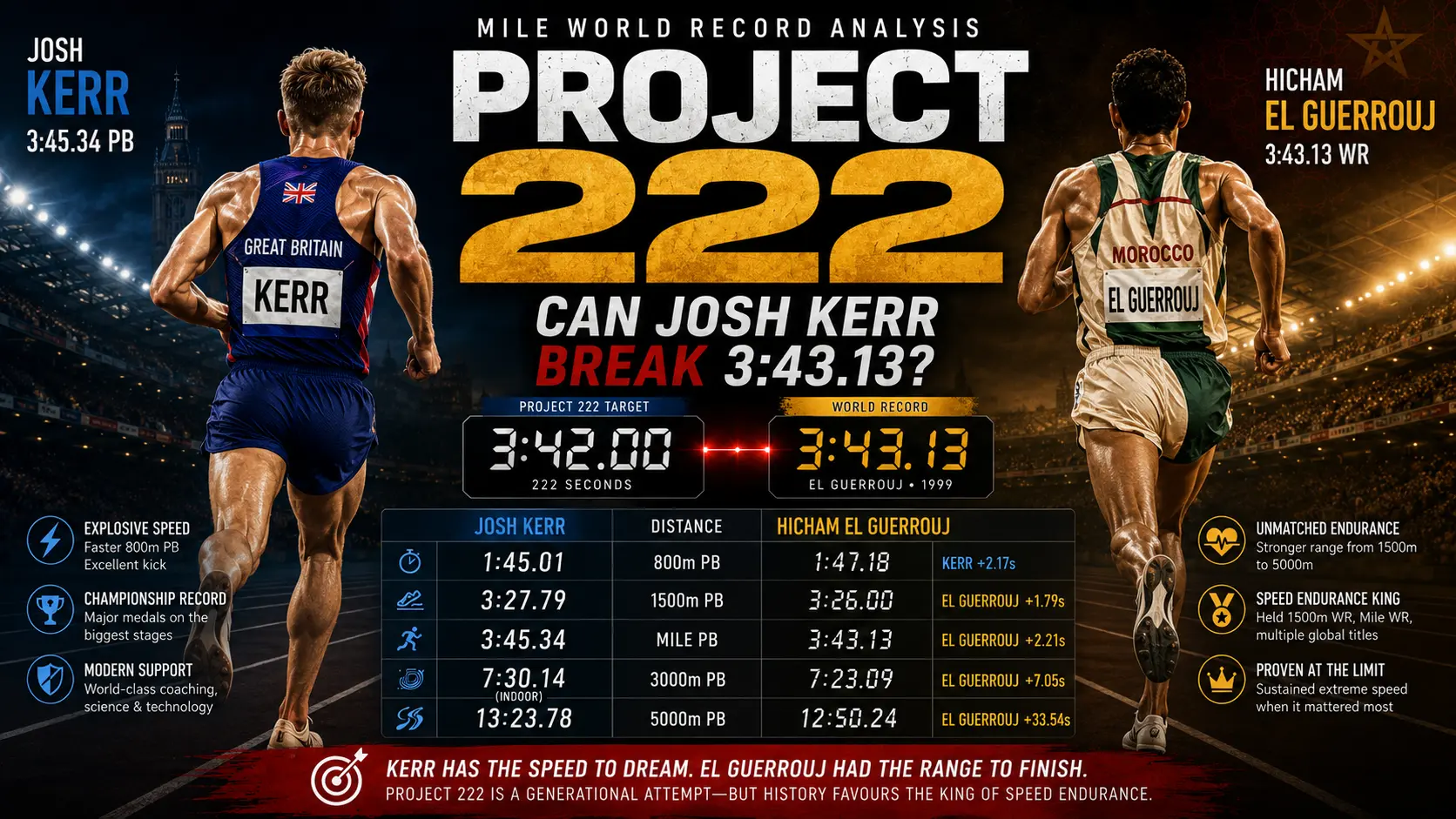
Kerr has publicly targeted Hicham El Guerrouj’s 3:43.13 world record, set in Rome in 1999. The attempt has been promoted as Project 222, referring to the approximate number of seconds required to run below 3:43.
This is not simply a controlled exhibition. Nuguse, one of the fastest milers in history, has joined the field and has no obligation to protect Kerr’s pacing plan. He can use the same pacemakers, remain sheltered behind Kerr and race for the win.
Read ITC’s original physiological analysis: Josh Kerr Project 222: Why Hicham El Guerrouj’s Mile World Record May Survive .
Complete Emsley Carr Mile field: 2026 season bests and personal bests
The official start-list data provides each athlete’s 2026 season best and personal best for 1500 metres. It does not provide a current mile season best for every entrant. Therefore, the table below preserves the published 1500m comparison while separately identifying the leading verified outdoor mile personal bests.
| Athlete | Nation | 2026 1500m SB | 1500m PB | Important mile evidence | ITC role |
|---|---|---|---|---|---|
| Josh Kerr | Great Britain | — | 3:27.79 | 3:45.34 outdoor mile PB | Record challenger |
| Yared Nuguse | United States | 3:30.11 | 3:27.80 | 3:43.97 outdoor mile PB | ITC favourite |
| Ethan Strand | United States | 3:32.54 | 3:30.25 | Strong NCAA-level progression | Podium contender |
| Neil Gourley | Great Britain | 3:40.79 | 3:30.60 | European indoor mile record holder | Experienced challenger |
| Robert Farken | Germany | 3:32.46 | 3:30.80 | Recent fast mile form reported in Eugene | Top-five contender |
| Jake Heyward | Great Britain | 3:32.09 | 3:31.08 | Strong international championship experience | Top-six contender |
| Simeon Birnbaum | United States | 3:31.69 | 3:31.69 | 2026 career-best form | Breakthrough candidate |
| Nathan Green | United States | 3:32.46 | 3:32.20 | Strong closing ability | Top-eight contender |
| Samuel Prakel | United States | 3:32.76 | 3:32.76 | Experienced indoor and mile racer | Chasing group |
| Arlo Ludewick | Great Britain | 3:33.07 | 3:33.07 | Career-best season | Chasing group |
| Žan Rudolf | Slovenia | 3:34.23 | 3:34.23 | Experienced international pacemaker | Expected pacer |
| Thomas Keen | Great Britain | 3:34.40 | 3:34.40 | Career-best 2026 form | Chasing group |
| Brannon Kidder | United States | 3:35.93 | 3:35.27 | Brooks Beasts teammate and experienced pacer | Expected pacer |
| Mohamed Abdilaahi | Germany | — | 3:35.36 | Won a 3000m Diamond League race earlier in 2026 | Chasing group |
Pacemakers and the expected record plan
Žan Rudolf and Brannon Kidder are the most likely athletes to perform pacing duties. Kidder’s connection with Kerr’s Brooks Beasts training environment makes him particularly valuable for maintaining a familiar rhythm and placing Kerr in the correct position.
The exact pacing order and assigned withdrawal points had not been formally detailed in the public start-list information reviewed. The likely strategy is for one pacer to control the first 600–800 metres and the second to carry Kerr toward approximately 1000–1200 metres.
The pacers must be fast enough to hold record rhythm but controlled enough to avoid a destructive opening lap. A first lap near 54 seconds could damage the attempt, while a first lap slower than approximately 56 seconds would leave too much work for the final 1200 metres.
Could Kerr’s lack of outdoor 1500m and mile racing hurt him?
This is the central concern in ITC’s prediction.
Kerr has demonstrated strong general fitness. His 1:44.60 over 800m confirms that he possesses enough speed for the required mile velocity. His indoor performances also show that his aerobic system and championship ability remain strong.
However, none of those races perfectly reproduces the task he faces in London.
An 800m confirms speed—not mile-specific durability
A 1:44.60 800m averages approximately 52.3 seconds per lap. That proves Kerr has considerable speed reserve relative to 55.5-second mile pace.
But the mile world record is not limited by whether Kerr can run one or two laps quickly. The challenge is maintaining approximately 55–56 seconds per lap for four laps while controlling lactate accumulation, preserving mechanics and producing another acceleration after 1400 metres.
What Kerr has not rehearsed publicly in 2026
- Passing 800m near 1:51 in an outdoor 1500m or mile race.
- Holding approximately 55–56-second rhythm through 1200m.
- Transitioning from pacemakers to running alone at record pace.
- Responding when a world-class rival remains directly behind him.
- Closing the final 300–400m after sustained record-level aerobic stress.
Why limited racing can also help
There is another side to the argument. Kerr may arrive fresh, healthy and uncompromised by a long Diamond League campaign. His coaches may have deliberately avoided unnecessary races so every training block could target July 18.
That strategy can work—but it increases uncertainty. The public evidence tells us Kerr is fit; it does not prove he is currently ready to run 3:42 or 3:43.
Why Yared Nuguse may be the athlete who benefits most
Josh Kerr
Yared Nuguse
Nuguse’s mile PB is 1.37 seconds faster than Kerr’s. More importantly, Nuguse has already completed nearly the exact performance London requires. He knows how his body responds when passing 1500m in approximately 3:29 and continuing for another 109 metres.
He also has the tactical advantage of not being responsible for the attempt. Kerr and his pacemakers must create the race. Nuguse can draft, observe and decide whether to follow the full record pace or allow a small gap before attacking late.
What does a 3:43 mile actually require?
Hicham El Guerrouj’s 3:43.13 represents an average of approximately 55.47 seconds per 400 metres.
| Distance | World-record pace | 3:44.00 pace | What it means |
|---|---|---|---|
| 400m | Approximately 55.5 | Approximately 55.7 | The opening must be fast but relaxed. |
| 800m | Approximately 1:50.9 | Approximately 1:51.4 | The field will already be running close to 1500m PB intensity. |
| 1200m | Approximately 2:46.4–2:46.7 | Approximately 2:47.1 | This is where the second pacer may withdraw. |
| 1500m | Approximately 3:27.9–3:28.2 | Approximately 3:28.8 | The athlete still has 109.34m remaining. |
| Finish | 3:43.13 | 3:44.00 | Less than one second separates history from an outstanding near miss. |
This explains why running 3:27 or 3:28 for 1500m does not automatically mean an athlete can break the mile record. The athlete must reach nearly the end of a world-class 1500m and then sustain maximum speed for another 109 metres.
Three likely race scenarios
Scenario one: the pacemakers are perfect
Kerr reaches 800m near 1:51.0 and 1200m near 2:46.8. Nuguse remains directly behind. Kerr takes over when the pacer withdraws, but Nuguse attacks late.
This is ITC’s central scenario: both run approximately 3:44, with Nuguse winning narrowly.
Scenario two: Kerr fully converts his preparation
Kerr reaches 1200m under control, maintains form through 1400m and prevents Nuguse from passing. He wins in approximately 3:43.6–3:44.0.
This would require Kerr to improve substantially on his mile PB while successfully converting a season built around limited race-specific competition.
Scenario three: record pace becomes too aggressive
The field passes 800m too quickly, the second pacer cannot maintain a smooth rhythm, or Kerr presses too hard between 900m and 1200m. Both Kerr and Nuguse slow sharply during the final lap.
In this scenario, the winning time could drift toward 3:45–3:46, while Strand, Farken or another athlete closes from the chasing group.
ITC predicted results
Yared Nuguse
Uses Kerr and the pacemakers, then takes control in the final 200–250m.
Josh Kerr
Runs an outstanding British-record-level performance but loses momentum late.
Ethan Strand
Runs conservatively behind the record group and finishes strongly.
| Predicted place | Athlete | ITC predicted time | Prediction basis |
|---|---|---|---|
| 1 | Yared Nuguse | 3:44.06 | Best proven mile performance and ideal tactical position. |
| 2 | Josh Kerr | 3:44.38 | Exceptional preparation and speed, but limited outdoor race-specific evidence. |
| 3 | Ethan Strand | 3:47.18 | Strong 1500m ability and opportunity to follow the leading group. |
| 4 | Robert Farken | 3:47.82 | Current form and recent mile performance support a fast result. |
| 5 | Simeon Birnbaum | 3:48.36 | Career-best 2026 progression and strong competitive momentum. |
| 6 | Jake Heyward | 3:48.71 | Experienced and capable of surviving a fast early pace. |
| 7 | Nathan Green | 3:49.04 | Strong finisher who may gain places in the closing lap. |
| 8 | Neil Gourley | 3:49.42 | High career level, but published 2026 outdoor form is less convincing. |
| 9 | Samuel Prakel | 3:49.89 | Experienced miler likely to remain in the secondary group. |
| 10 | Arlo Ludewick | 3:50.41 | Career-best season, although the pace may stretch him after 1200m. |
| 11 | Thomas Keen | 3:50.86 | Strong 2026 PB but entering a much faster international race. |
| 12 | Mohamed Abdilaahi | 3:51.20 | Strong endurance but less direct 1500m evidence on the published list. |
| — | Žan Rudolf | Pacemaker / likely DNF | Expected to assist during the opening portion. |
| — | Brannon Kidder | Pacemaker / likely DNF | Expected to carry the record group deeper into the race. |
Final verdict: Nuguse wins, Kerr runs 3:44-low and the record survives
ITC prediction: Yared Nuguse wins the Emsley Carr Mile in 3:44.06. Josh Kerr finishes second in 3:44.38.
Kerr’s 1:44.60 800m demonstrates excellent speed, but speed is not the principal uncertainty. The question is whether he has enough race-specific rhythm and resistance to sustain record pace after the pacemakers leave.
Nuguse has already run 3:43.97 and can enter the race without carrying responsibility for the record attempt. That combination gives him the stronger statistical and tactical position.
Kerr may still prove this prediction wrong. His preparation has been designed around this single performance, and limited racing may leave him exceptionally fresh. But before the gun, the safest evidence-based prediction is that Nuguse follows the attempt, passes Kerr late and wins in the low 3:44 range.
Frequently asked questions
What is ITC’s predicted winning time?
ITC predicts Yared Nuguse to win in approximately 3:44.06.
What time does ITC predict for Josh Kerr?
ITC predicts Kerr to finish second in approximately 3:44.38.
Why is Nuguse favoured over Kerr?
Nuguse has the faster outdoor mile PB, has already run 3:43.97 and can use Kerr and the pacemakers tactically before attacking late.
Has Josh Kerr raced in 2026?
Yes. Kerr raced indoors over longer distances and ran 1:44.60 for 800m outdoors. The concern is his lack of a published 2026 outdoor 1500m or mile performance before the record attempt.
Can an 800m race prepare Kerr for the mile?
It confirms speed and can sharpen mechanics, but it does not fully reproduce four continuous laps at 55–56-second pace or the aerobic fatigue of the final 400m of a record attempt.
Who are the expected pacemakers?
Žan Rudolf and Brannon Kidder are expected to serve pacing roles, although the precise pacing order and assigned distances require official confirmation.
What is the mile world record?
Hicham El Guerrouj holds the outdoor men’s mile world record at 3:43.13, set in Rome in 1999.
Sources and further reading
- London Diamond League — confirmed meeting line-up
- British Athletics — Josh Kerr confirmed for the Emsley Carr Mile
- World Athletics — Josh Kerr profile and performances
- World Athletics — Yared Nuguse profile and performances
- London Diamond League start lists and event schedule
- ITC — Josh Kerr Project 222 world-record analysis
Editorial note: Predictions are analytical estimates, not guarantees. Start lists, pacemaker assignments, weather conditions and athlete readiness may change before the race. Season-best and personal-best data reflect the published start-list information available when this article was prepared.